The fastest quote I ever saw turned around took one phone call and one PDF. The buyer sent a clean drawing, a programmer read it in four minutes, and the price went out the same afternoon. Most quotes do not go that way. I have quoted machined parts since 1998, first inside shops and now on the buying side for overseas programs, and the gap between a one day quote and a two week quote is almost never the part. It is the drawing. Every ambiguity becomes an email, and every email pushes your RFQ to the back of a queue where a quoting engineer is already carrying twenty jobs. A quoting engineer prices the risk as much as the part. An ambiguous drawing reads as a buyer who does not know what they need, and that uncertainty shows up in the price as well as in the delay. Below are the drawing mistakes that delay machining quotes, what each one costs in turnaround time, and the ten minute check I run before any RFQ leaves my desk.
In this guide
- What actually delays a machining quote
- Missing or vague material callouts
- Tolerance and GD&T mistakes that trigger questions
- Half-specified geometry: threads, chamfers, and finish
- File problems: 3D only models and scanned PDFs
- What each mistake costs in quote turnaround
- A ten minute pre-send checklist
- Frequently asked questions
What actually delays a machining quote
When a shop takes five days to quote a part that a programmer could set up in an hour, the delay is in the questions. Someone on the quoting side has to stop, write an email, and wait for your answer. That interruption breaks the workflow, because the engineer moves to the next RFQ in the stack and your job sits until the answer lands. Two drawings for nearly identical parts can land quotes four days apart for exactly this reason. The part is not the variable. The drawing is. If you want the price faster, the work is on your side of the table: remove the questions instead of chasing the shop for urgency. What a complete request looks like from the receiving end is described on our CNC machining service page and on the how we work page, and both match what I now ask for when I quote on the buying side.
Missing or vague material callouts
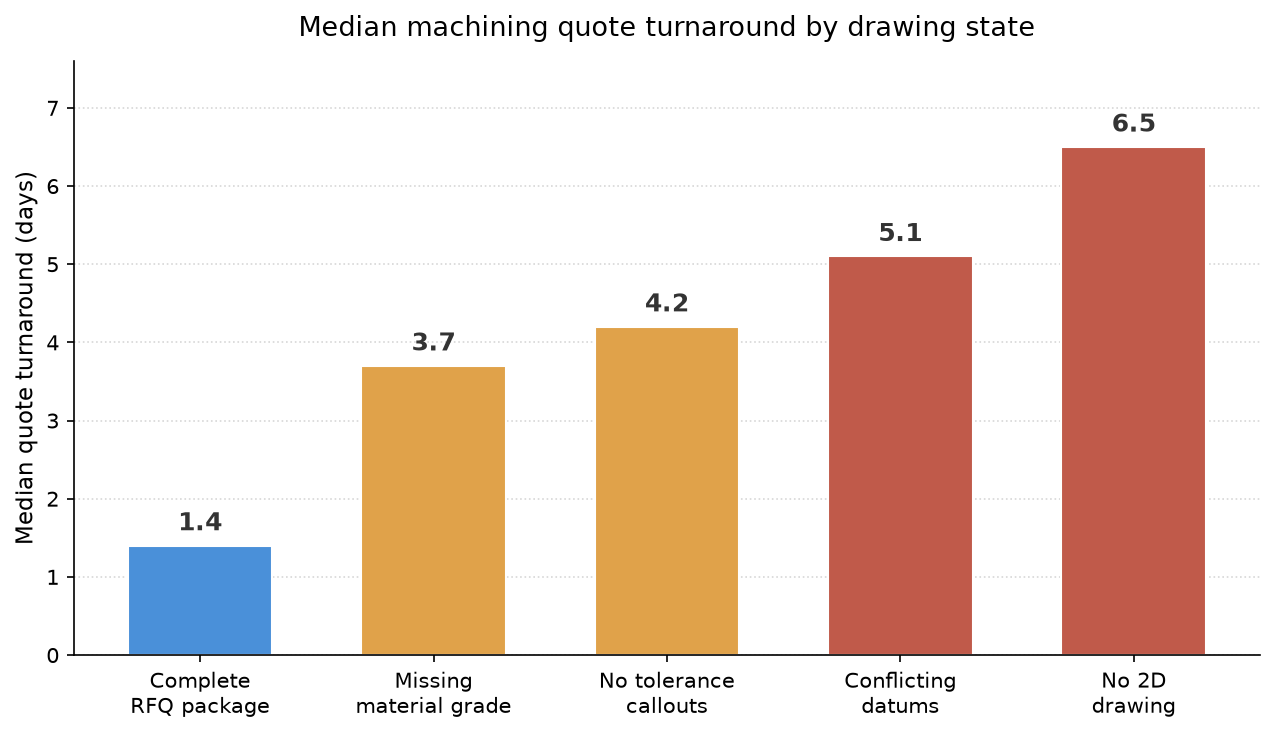
Aluminum is not a material callout. Stainless is not a material callout. I waited six days for one quote because a drawing said stainless steel and nobody could tell whether to price 304 or 316L. The distinction matters to the number: 316L costs more per kilogram, cuts slower, and changes the finishing route, so a careful shop will not guess. When the buyer finally wrote 316L per ASTM A276, the price arrived the next morning. Write the exact grade, standard, and condition: 6061-T6, 316L, 17-4PH H900. Heat treatment belongs on the same line, because 17-4PH without a condition such as H900 leaves the strength unresolved and the quote either assumes the cheapest condition or waits on you. If the choice is open, write "or equivalent, quote both", and the shop will return two numbers instead of one question. The detail a quoting engineer needs is spelled out on our aluminum 6061 and stainless steel 316L pages. In the RFQ packages I tracked last year, a missing material grade stretched the median quote turnaround from 1.4 days to 3.7.
Tolerance and GD&T mistakes that trigger questions
Tolerances cause more RFQ emails than any other block on the drawing. Three patterns repeat. First, no tolerances at all: nominal dimensions with nothing else, which leaves the shop to assume ISO 2768-m or ask. Second, blanket tight tolerances: every dimension gets plus or minus 0.025 mm whether it matters or not, so the shop prices every feature as a precision feature and the cost per part rises 20 to 40 percent. I would rather see 0.1 mm everywhere and 0.025 mm on the two bores that locate a bearing. Third, GD&T that references datums which do not exist or contradict each other. A position tolerance on a hole pattern, built through a surface nobody defined, will always earn a question, and the quote waits for the answer. Keep one convention, ASME Y14.5 or ISO GPS, and check that every datum letter appears on the part before you send. I keep a simple rule after twenty years of this: tolerance follows function. If nobody can name the function a dimension protects, its tolerance does not need to be tight. If the part feeds an automotive program, the drawing also has to survive PPAP level 3, so write the tolerances the way you will inspect them; our automotive page covers that flow. In my tracking, drawings with no tolerance callouts averaged 4.2 days to quote, and drawings with conflicting datums averaged 5.1.
Half-specified geometry: threads, chamfers, and finish
Threads, chamfers, and surface finish notes cause delays by omission. A hole marked M6 with no depth, no thread class, and no blind or through callout generates at least one email. Surface finish written as "good finish" means nothing to a quoting engineer. Ra 1.6 means a process, a cost, and sometimes a second operation on a separate machine. Chamfers without a size get assumed in the quote and argued about later, usually at first article inspection, which is the most expensive place in the program to have that argument. One line of text on the drawing removes one line of email, and an unanswered line of email costs a day or two of queue time. The callouts I most often see missing are covered on our pages for surface roughness requirements and thread tolerances on fasteners.
File problems: 3D only models and scanned PDFs
The worst file I received last quarter was a phone photo of a printout, taken at an angle, with a coffee stain across the title block. I did not quote it, and you would not either. More common and more forgivable is the 3D only RFQ: a STEP model with no 2D drawing attached. A model carries geometry, but it does not carry tolerances, finish, material condition, or which dimensions actually matter, so the quoting engineer either assumes or waits. In the packages I tracked, RFQs without a 2D drawing averaged 6.5 days to quote, about 5 days longer than a complete package. Send the STEP file and a 2D PDF together. The PDF is the contract and the model is the reference. State units on the title block and use one system; mixed inch and metric drawings, common on legacy aerospace prints, are a reliable source of wrong quotes and scrapped parts. If the shop asks for a native file, send it, and flatten any PDF that puts more than one part on a sheet unless you want the wrong one priced.
What each mistake costs in quote turnaround
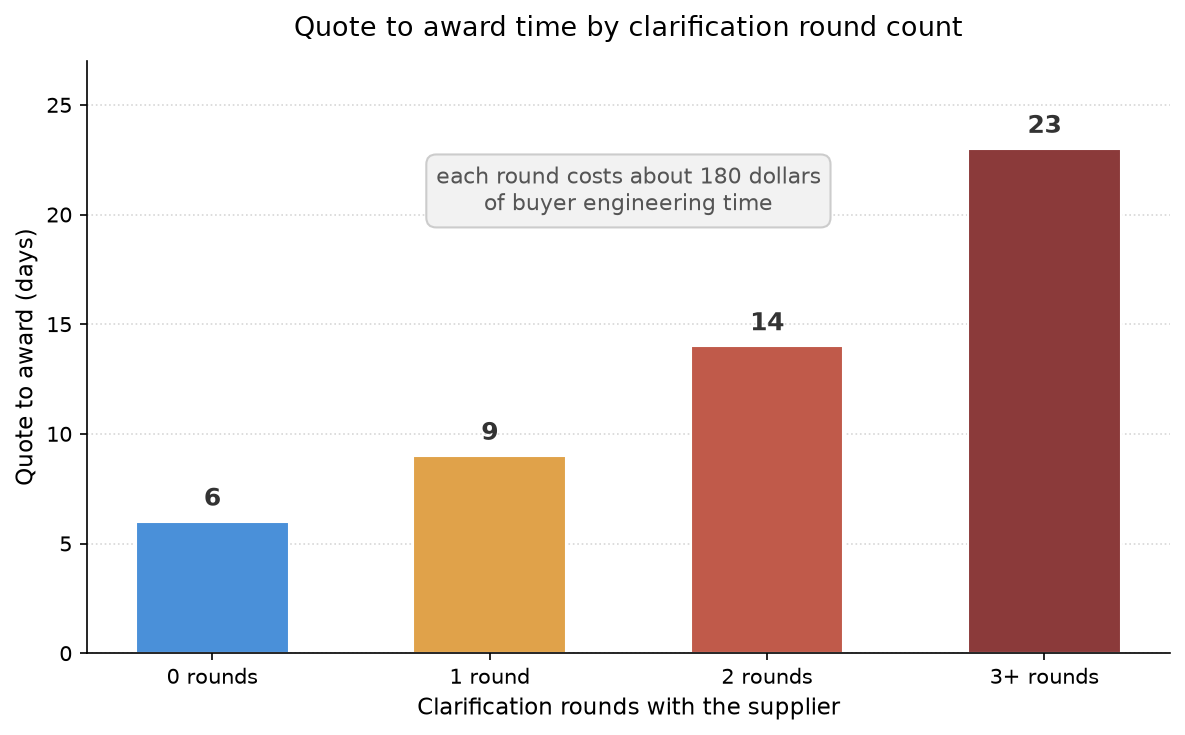
Numbers first. A complete RFQ package quotes in about 1.4 days at the shops I work with. A missing material grade stretches that to 3.7 days. Drawings with no tolerance callouts reach 4.2 days, conflicting datum schemes 5.1 days, and packages with no 2D drawing 6.5 days. The second cost is the clarification loop. Each round of questions costs a buyer about 180 dollars of internal engineering time, two hours at 90 dollars per hour, plus calendar days nobody gets back. Quote to award time runs about 6 days with zero clarification rounds, 9 days with one, 14 days with two, and 23 days with three or more. By the third round most quotes go stale, because the program moved on or a competitor with a cleaner drawing took the slot. And the 180 dollars is not the worst of it. A shop that assumes an answer instead of waiting may quote a price it cannot hold, and the problem surfaces at first article two months later, after tooling and fixtures are already committed. None of this changes with process: the same package works whether the part is machined, investment cast, or molded in metal, because a quoting engineer needs the same information either way.
A ten minute pre-send checklist
Ten minutes before you hit send: material grade, standard, and condition written out. Tolerances on every dimension, tight only where a function needs it. Datum letters that all exist on the part. Threads with size, pitch, depth, and class. Surface finish as an Ra value, never an adjective. Chamfer and deburr notes stated once, clearly. A 2D PDF and a STEP model attached together. Units on the title block. Your name on a reply address a stranger can reach. If any line fails, fix the drawing before the RFQ goes out, because fixing it afterwards costs about 180 dollars a round and up to two weeks of slip. I have watched buyers lose programs over drawings that needed ten minutes of editing, and I have never seen one lost over a drawing that was too clear. The preparation steps are laid out in our guide to preparing CAD drawings for a quote, and the habits that shorten response times are in our notes on getting faster quotes from Chinese machining suppliers. If a term on this page is unfamiliar, our FAQ spells out most of them in plain language, and the inspection expectations behind the tolerances are described under quality.
Frequently asked questions
How much does a missing tolerance callout add to a machining quote turnaround?
In the packages I tracked, drawings with no tolerance callouts averaged 4.2 days to quote against 1.4 days for a complete package. The gap is close to three days, and it comes from the shop stopping to wait for your answer.
Can a supplier quote from a 3D CAD file without a 2D drawing?
Some will, but slowly. RFQs without a 2D drawing averaged 6.5 days to quote in my tracking. The model carries geometry but not tolerances, finish, or material condition, so the quoting engineer either assumes or waits.
Why does an incomplete material spec slow down a machining quote?
The shop cannot pick cutting data, stock size, or the finishing route without a grade. In the packages I tracked, a missing material grade stretched the median quote turnaround from 1.4 days to 3.7.
What does each clarification round cost before a machining quote is awarded?
About 180 dollars of buyer engineering time per round, at two hours and 90 dollars per hour, plus calendar days: roughly 6 days to award with no rounds, 9 with one, 14 with two, and 23 with three or more.
What file format gives the fastest machining quote?
A 2D PDF with complete callouts plus a STEP model. That combination carried the 1.4 day median turnaround in my tracking, and it is the first thing most shops ask for.
Need Precision Metal Parts for Your Project?
Yujiaxin Tech specializes in MIM, CNC Machining, Powder Metallurgy, Investment Casting, and Gear Hobbing. Get a free quote within 24 hours.