Buyers ask me some version of the same question every week: how do I know a metal parts supplier has really shipped into Europe before, instead of only saying so? I have sent precision components into Hamburg, Rotterdam, and Milan since 2003, and I judge the answer in paperwork and pallets, never in brochures. A factory with genuine European experience leaves evidence in every certificate, crate, and quotation. One without it shows cracks the first time you look closely. This guide walks through the checks I run before a new supplier touches a European order. Every number below comes from a real shipment.
In this guide
- What export experience looks like on paper
- The document package a European buyer should demand
- CE, REACH and RoHS obligations
- CBAM changes the steel conversation in 2026
- Packaging and pallets, where first impressions fail
- Incoterms and who carries the risk
- How I verify a supplier's European track record
- Questions buyers ask about exporting parts to Europe
What export experience looks like on paper
The fastest signal is how a supplier answers a request for an EN 10204 3.1 material certificate. A factory that ships into Europe regularly produces a certificate with the real heat number, chemical composition, and mechanical test results tied to your lot, usually within one working day. A factory that rarely exports sends a template with blank fields, or a 2.2 certificate where the mill certifies nothing. I watched a buyer accept one once, and that decision turned into a 4,000 dollar recertification bill when the end customer's auditor rejected the lot.
The second signal sits in the quotation itself. Experienced exporters quote in the Incoterms you named, list the HS code they will use for customs, and state which documents travel with the shipment. When I read a quote and none of that appears, I ask one question: how many European customers do you ship to per month? A factory with real volume answers with a number and a port. One without it answers with a brochure page. The pattern is easy to test early on a low volume order, for example a CNC machined bracket quoted in ten pieces, where the documentation burden matches a production run.
The document package a European buyer should demand
Get the full document list in writing before the first order. My minimum set for steel and stainless components reads like this: EN 10204 3.1 material certificates, a REACH declaration against the SVHC candidate list, a RoHS declaration where coatings or electrical contact are involved, ISPM 15 heat treated pallets with a visible HT stamp, and a CE Declaration of Conformity when the assembly the part enters carries CE marking.
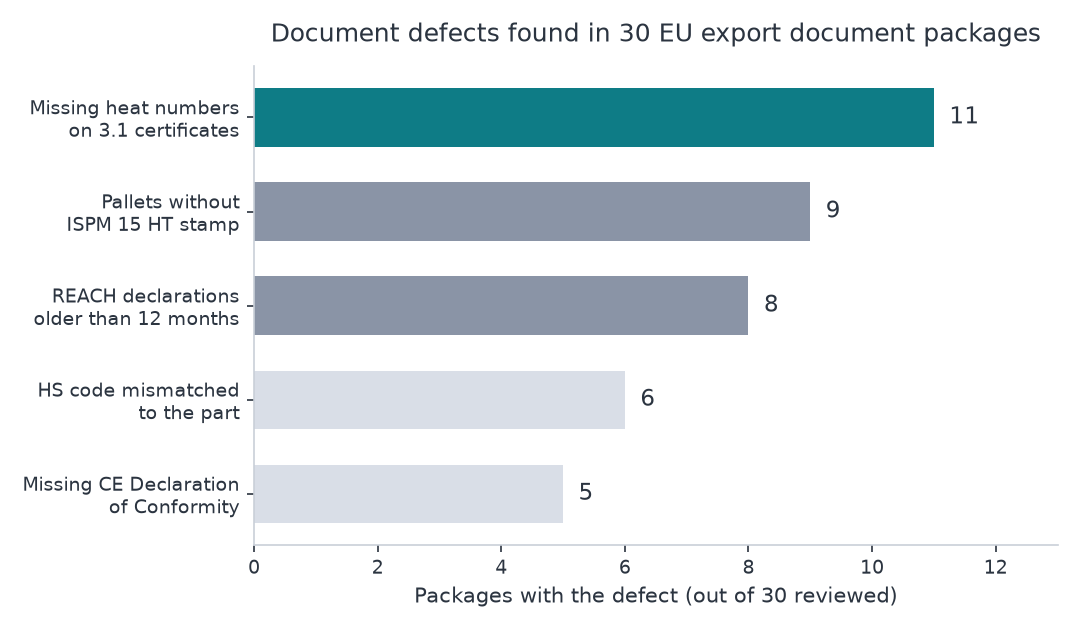
I reviewed 30 document packages from suppliers shipping into Europe over the past two years. Eleven were missing heat numbers on 3.1 certificates, nine used pallets without the ISPM 15 stamp, eight carried REACH declarations written before the latest SVHC update, six used an HS code that did not match the part, and five lacked a CE Declaration of Conformity where one applied. Figure 1 shows the spread. None of those factories was new to exporting, which is the uncomfortable part. Experience without checks drifts.
The SVHC candidate list now carries more than 240 entries and is updated roughly twice a year. A REACH declaration older than twelve months is out of date on arrival, and a customs broker or customer auditor will flag it.
CE, REACH and RoHS obligations
A raw metal component usually does not need CE marking itself. CE applies to the finished product, the machine it goes into. What the supplier owes you is traceability that lets your own CE file stand up under audit: material certificates, dimensional reports, and a REACH statement for the alloy and any surface treatment. If the part carries zinc plating or a powder coat, the declaration needs to cover the coating chemistry too, because restricted substances under RoHS catch plated parts that end up in electrical assemblies.
I ask suppliers three direct questions. Which SVHC list date does your REACH declaration reference? Can you produce a RoHS declaration for the coating system? Do you hold a DoC template for assemblies you already ship? A supplier who answers all three with dates and document numbers ships into Europe weekly. One who answers vaguely is learning on your order. If you want the full list, our article on RoHS and REACH compliance works through it in order.
CBAM changes the steel conversation in 2026
If your parts are iron, steel, or aluminum, the Carbon Border Adjustment Mechanism is now part of the import conversation. The transitional reporting phase ran from October 2023, and the definitive regime with certificate purchases applies to covered goods from 2026. In practice the importer of record in the EU files embedded emissions data, and the supplier must provide mill level emission figures or default values. I quoted several steel programs this year where the European buyer asked for CBAM data before they asked for price. When a supplier cannot say whether they will report default or actual emission values, that is a gap you will pay to close later. On a 10,000 dollar steel order I budget about 150 dollars of administration for the first CBAM filing and far less on repeats once the data set exists.
Packaging and pallets, where first impressions fail
Parts that pass inspection in Shenzhen and fail on arrival in Rotterdam share one cause more often than any other: packaging written for domestic China transport, not for six weeks at sea. My standard for European shipments reads like this: VCI paper on machined surfaces, desiccant inside the poly bag, humidity indicators where the end customer requires them, and export grade lumber stamped ISPM 15. The HT stamp matters because EU customs can hold shipments on non compliant wood packaging, and a hold at Rotterdam runs one to two weeks, which turns an on time program into an expedite conversation.
Rust claims follow the same pattern. Carbon steel parts wrapped in plain poly and crated for a monsoon season transit arrive with orange film inside the bag. I now treat a supplier's packaging spec as a quality document and audit it the same way. If a supplier cannot describe their export crate in three sentences, they have not shipped enough to Europe. The same logic applies to cast components: when we ship investment cast stainless housings, the crate spec goes into the quote because an as-cast 316L surface marks easily against loose packing foam. For small batches the crate is only half the freight problem; our article on shipping small volume machined parts covers consolidation that keeps air freight off the invoice.
Incoterms and who carries the risk
Most of my European orders ship FCA or DAP. DDP looks generous on paper and hides two problems: the supplier's declared value drives your import VAT base, and EU VAT registration on the exporter's side is a complexity you inherit. FCA or DAP keeps customs clearance with your own broker, who knows your EORI number and your duty history. Duty classification matters more than most buyers expect. Most wrought steel components land under HS 7326 with a duty rate near 2.7 percent, and a wrong code can push that number far higher or trigger a customs query that holds the container.
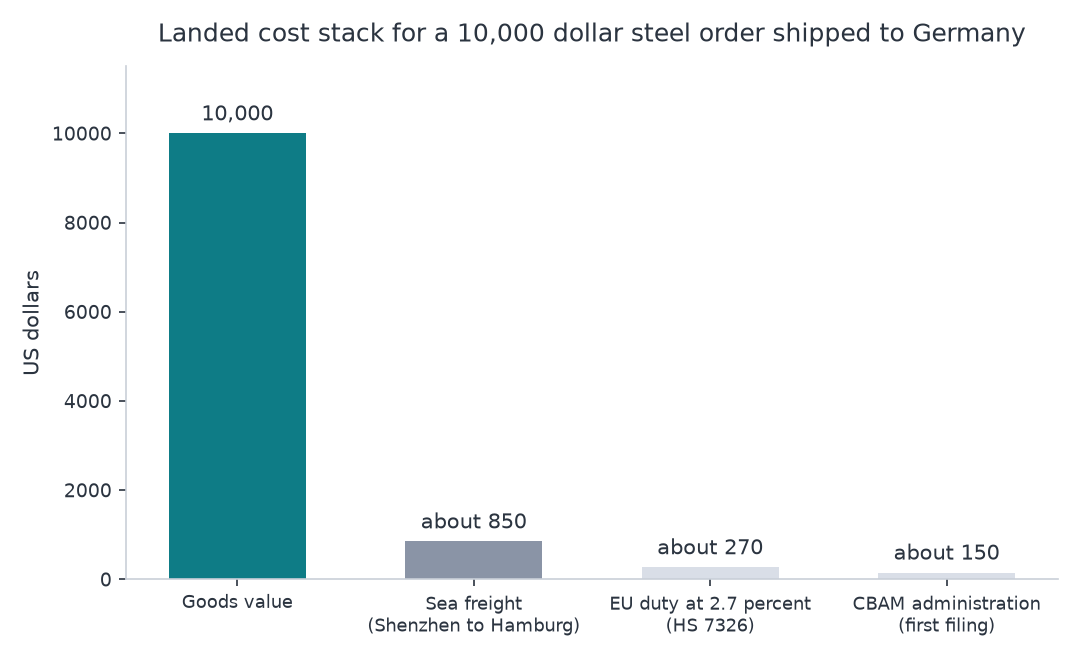
On a 10,000 dollar steel order shipped to Germany, my landed cost model adds about 850 dollars of sea freight, 270 dollars of EU duty at 2.7 percent, and 150 dollars of CBAM administration on the first filing. Figure 2 shows the stack. Import VAT is charged at entry and recovered through your filing, so I model it as cash flow, not cost. The method sits in our article on landed cost for imported metal parts, and the risk split by term is in our Incoterms piece.
How I verify a supplier's European track record
I use four checks, in this order. First, ask for two European customer references with industry and country, not the name if they cannot share it. Automotive customers will not give permission, but country and sector tell you almost as much, and expectations on those programs follow automotive sourcing requirements. Second, request a blank 3.1 certificate and a REACH declaration from a recent lot and check the dates. Third, ask which European port they ship to most often and which forwarder they use. A supplier who names Rotterdam and a forwarder without hesitation has done this before. Fourth, ask what went wrong on their last European shipment and how they fixed it. The honest answers I have heard include a customs hold over a pallet stamp and a rust claim resolved with VCI paper. A supplier who says nothing ever goes wrong is either new or hiding something, and both are expensive.
Material choice shapes the document set too, because mill paperwork for 316L stainless steel carries composition limits and corrosion test options that carbon steel does not. Our how we work page shows where each document lands on a first order, and the FAQ answers the questions European buyers raise before signing. For miniature MIM components shipped into regulated products the same checks apply with tighter lot control, and metal injection molding parts carry full heat traceability from feedstock lot to sinter batch, which is what a European auditor asks for first.
Questions buyers ask about exporting parts to Europe
How do I check if a supplier has real European export experience?
Run four checks: ask for two customer references with country and industry, request a recent EN 10204 3.1 certificate and REACH declaration and check the dates, ask which EU port and forwarder they use most, and ask what went wrong on their last European shipment. A supplier with weekly volume answers all four with specifics in one email.
What documents must accompany metal parts imported into the EU?
Commercial invoice, packing list, EN 10204 3.1 material certificates, a REACH declaration against the current SVHC list, a RoHS declaration where coatings apply, and a CE Declaration of Conformity when the end assembly carries CE marking. Pallets must be ISPM 15 heat treated with a visible HT stamp.
Does CBAM apply to my steel parts order?
If the goods fall under the covered iron, steel, or aluminum categories, yes, the EU importer of record files embedded emissions data and the supplier provides mill level or default emission values. On a 10,000 dollar steel order I budget about 150 dollars of administration for the first filing.
What pallets are required for shipping parts to Europe?
Wood packaging must be ISPM 15 heat treated and stamped HT. Non compliant pallets risk a customs hold of one to two weeks at entry ports such as Rotterdam or Hamburg, which is long enough to miss a production slot at the customer.
Which Incoterm is safest for a first order from China to the EU?
FCA or DAP. Both keep customs clearance with your own broker, who knows your EORI number and duty history. DDP hides declared value and VAT handling inside the supplier's price and hands you a tax complexity you never negotiated.
None of these checks takes more than one email. Together they separate factories that serve Europe weekly from factories that would like to start with your order. I run all four before accepting a European program, because a missing certificate always costs the buyer's side of the table more than the seller's.
Need Precision Metal Parts for Your Project?
Yujiaxin Tech specializes in MIM, CNC Machining, Powder Metallurgy, Investment Casting, and Gear Hobbing. Get a free quote within 24 hours.