The last rapid prototype quote I opened said three days. Five 6061-T6 brackets, a STEP file, one PDF drawing with a ±0.025 mm bore callout. The buyer had told his test team the parts would be on the bench by Friday. They arrived the following Wednesday. The machining was fine. Those three days covered the shop floor only, and nobody had mentioned CAM programming, the CMM report, or the two and a half days in transit.
Ordering rapid prototype machined parts in China is mostly the work of making a quote mean what you think it means. I have quoted these jobs since 1998, and the same failures return: a drawing that cannot be priced in one pass, a tolerance that doubles the price, and a first article shipped with no measurements. Here are the questions I ask before I release a purchase order, using numbers from a real five-piece order.
On this page
- What rapid means on a machining quote
- Drawings a shop can quote the same day
- Material and tolerance choices that move the price
- What prototype cost per part should include
- Lead time, freight and the buffer I build in
- Samples, first article inspection and how many to approve
- Reusing the prototype drawing when volume arrives
- Frequently asked questions
What rapid means on a machining quote
Rapid means no tooling. It does not mean 24 hours. A machined prototype starts from bar stock, so what you wait for is programming, machine time, inspection and freight. A metal injection molding tool takes four to six weeks before the first shot, and a wax tool for investment casting needs two to three weeks. When a program needs five parts by Friday, machining is the only route I quote.
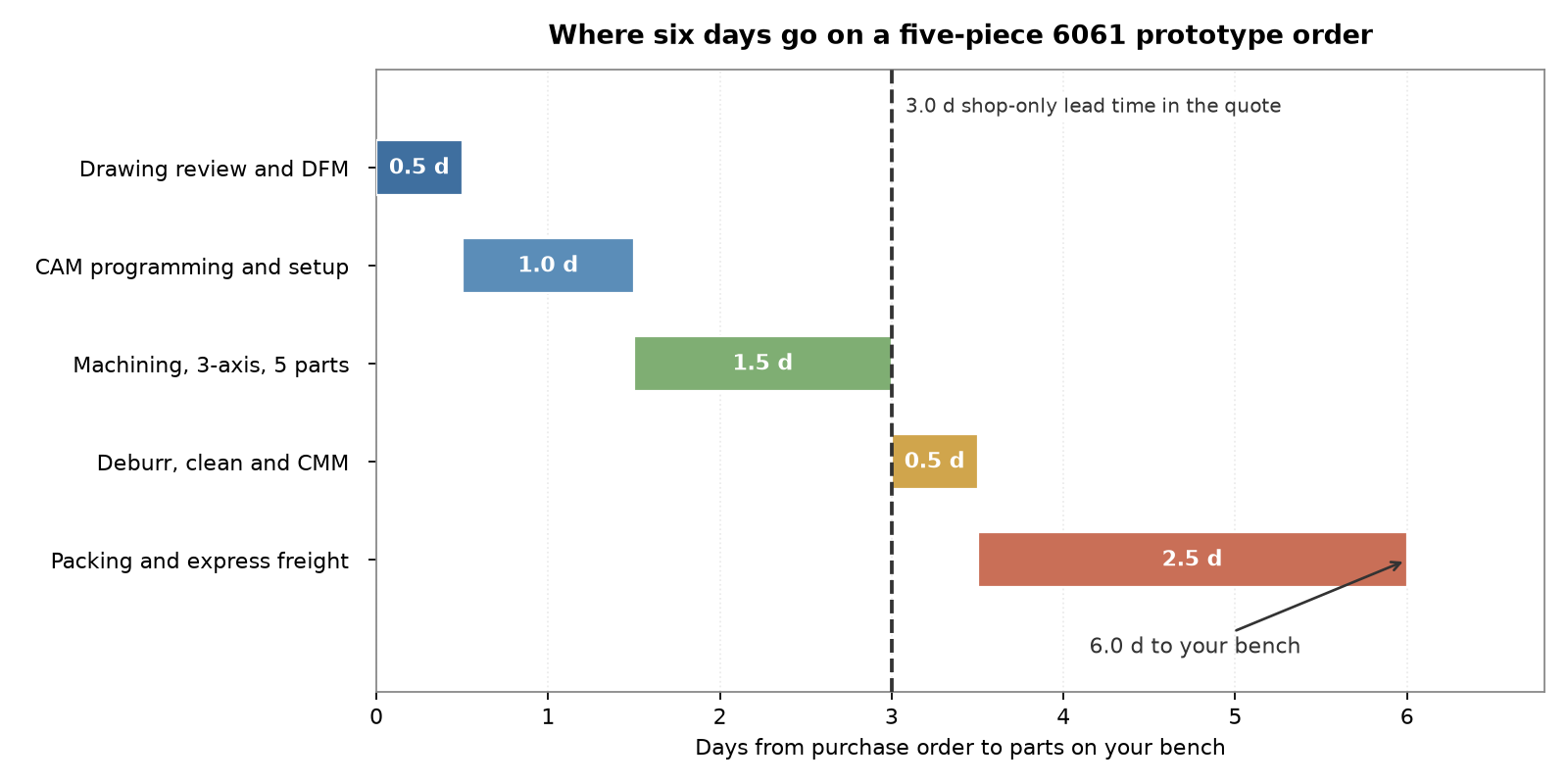
For a five-piece 6061-T6 bracket, the six days break down as 0.5 day drawing review and DFM, 1.0 day CAM programming and setup, 1.5 days on a 3-axis mill, 0.5 day deburr, clean and CMM inspection, and 2.5 days export packing and express freight. That is 6.0 days from purchase order to parts on your bench. The 3.0 day figure in most quotes stops at the deburr bench.
I distrust a rapid prototype lead time quoted without a start point and an end point. Ask which one the supplier means. That answer tells me more about the shop than the number does.
Drawings a shop can quote the same day
A STEP file alone gets you a maybe. A STEP file plus a 2D PDF with a datum scheme, material grade, surface finish, quantity and inspection requirement gets you a fixed price the same day. I send both, with ISO 2768 m in the title block for anything left unspecified. A general ±0.10 mm on faces that do nothing costs nothing extra. A ±0.025 mm callout on every dimension costs a lot.
Two details slow quotes down most. A true position tolerance written as a coordinate box, where a datum reference frame would let the machinist hold 0.1 mm at MMC. And a roughness with no measurement method behind it. Ra 1.6 micrometers on a sealing face is a different job from Ra 3.2 micrometers on a bracket, and I have seen both ordered as "smooth". Our note on preparing CAD drawings for a machining quote spells out the format.
I trust the shop that sends back two DFM questions more than the one that answers yes to everything. A yes to a blind hole with a 0.5 mm floor is a quote written to win an order, not make a part. How we work and the FAQ describe the review step. A question on day one costs less than a rework note on day six.
Send the revision number with the part number and keep a dated copy of the STEP. Buyers in the electronics industry are careful here. I have seen revision B machined against a revision C test rig.
Material and tolerance choices that move the price
Material sets cycle time before tolerance does. Aluminum 6061-T6 runs near 300 m/min and clears chips easily, which is why it is my default for a bracket that only holds shape. 316L stainless steel work hardens if the tool rubs, so feeds stay positive and the cycle stretches. Ti-6Al-4V cuts at about 60 m/min and costs roughly 2.3 times the 316L blank, so a titanium prototype can take four times the shop hours.
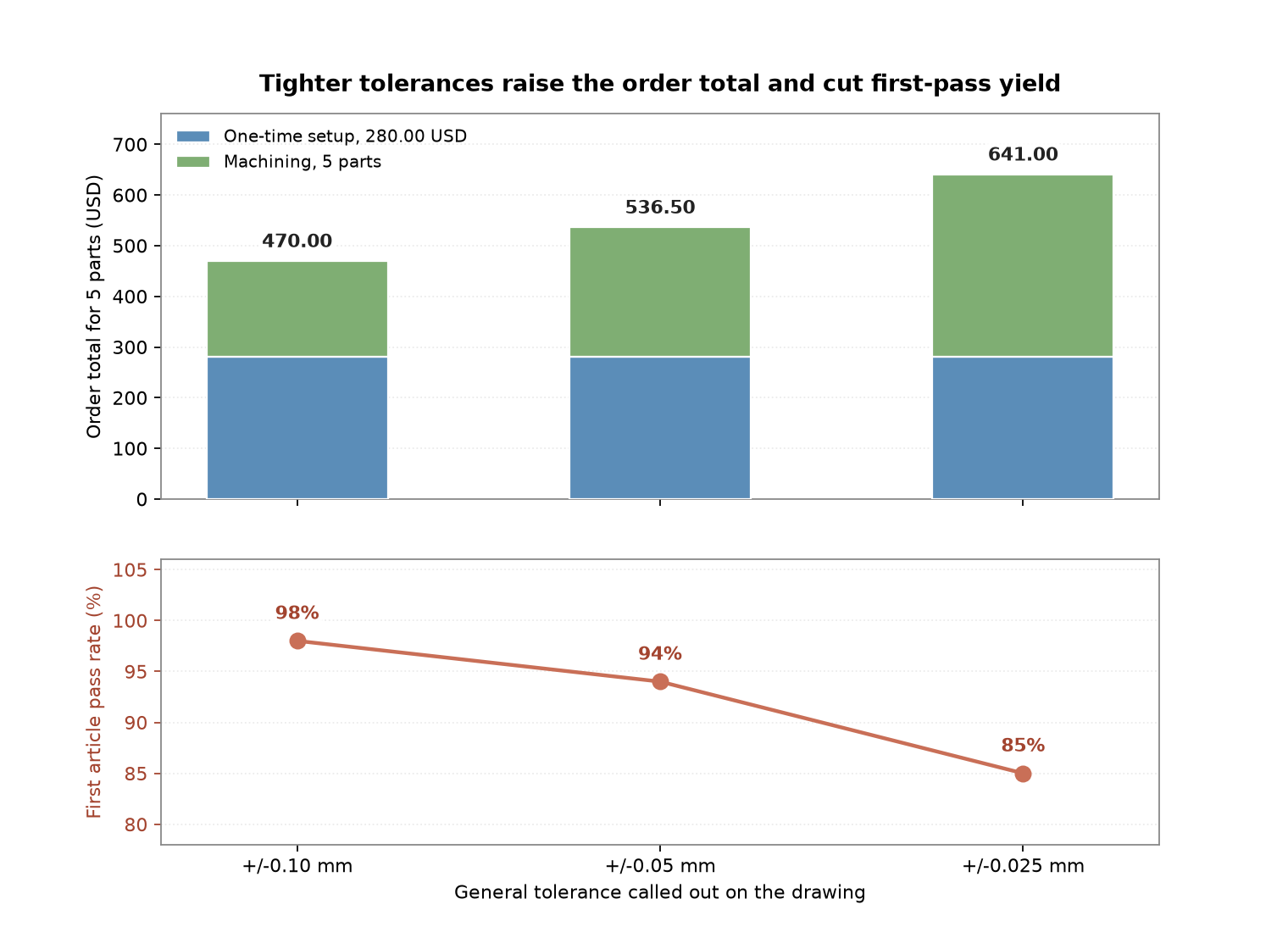
Tolerance is the second multiplier. On that bracket, a general ±0.10 mm put machining at 38.00 dollars per part. Tightening to ±0.05 mm took it to 51.30 dollars. A blanket ±0.025 mm landed at 72.20 dollars, because the shop adds a finishing pass, a temperature-controlled inspection and a slower feed. Those are machining cost per part, before the one-time setup.
First article pass rate moves with them: 98 percent at ±0.10 mm, 94 percent at ±0.05 mm, 85 percent at ±0.025 mm. That last figure is the one buyers miss. A tight drawing costs more and produces more scrap. I have watched a buyer lose two weeks because a ±0.025 mm callout sat on a face nobody had datum'd.
What prototype cost per part should include
A prototype quote has a fixed half and a variable half. On this order the fixed half was 280.00 dollars: 3.7 hours of CAM programming and setup at 75 dollars per hour, a soft fixture cut from tool steel M2 for the second operation, and an inspection plan. The variable half is the machining cost per part above.
For five parts, that gives order totals of 470.00, 536.50 and 641.00 dollars, or 94.00, 107.30 and 128.20 dollars per part. Order twenty instead of five and the 280.00 dollars spreads to 14.00 dollars a part, so the ±0.10 mm version falls to 52.00 dollars each. That is the reason to order a few extra prototypes while the design is still moving.
Ask whether the number includes deburr, a material certificate, a CMM report, export packing and freight. On five parts those lines add 60 to 110 dollars, more than the gap between the two loose tolerance bands. I would rather pay 94 dollars for five parts I can measure than 38 dollars for five I cannot. The hidden fees in a CNC quote note goes line by line, and our quality page lists the documents we issue.
Lead time, freight and the buffer I build in
Those six days assume a clean drawing, material on the shelf, and no second operation off site. A 316L blank that has to be ordered adds two days. Hardcoat anodize sent out adds three. Express freight from Shenzhen to a US bench runs 2.5 days when customs cooperates, and I have seen it take five.
I build a 40 percent buffer into any prototype date a test rig depends on. I have never needed less. Chinese New Year closes most shops for two to four weeks, air freight rates rise 30 to 60 percent in the fourth quarter, and one customs query on an HS code can hold a box for a day.
Ship the prototypes as one parcel. I once air-freighted nine kilograms of foam around four small 6061 parts because a buyer asked for weekly releases. One carton, one invoice. The saving beat the machining.
Samples, first article inspection and how many to approve
There is no minimum order quantity for prototype machining. One part is a valid order. I still ask for three to five. One goes on the test rig, one into the assembly, one stays as the approved sample, and one gets pulled to failure if the design carries load. A single sample answers one question.
Ask for the measured report before the parts ship. I want a bubble drawing tied to measured values, the material certificate, and the roughness reading on any sealing face. On aerospace programs an AS9102 form 1, 2 and 3 bundle is normal. On automotive programs the buyer asks for PPAP Level 3 before production, not before prototypes. Other regulated programs carry their own paperwork, and mixing them up loses a week.
Cpk 1.33 belongs to a production process, not a five-piece prototype. Asking for it here gets a number computed from too few samples. I read the first article inspection note and check reports the same way each time: units, datum references, the instrument used, and whether every part was measured. A report with one row for five parts is a report about one part.
Reusing the prototype drawing when volume arrives
A prototype drawing is a learning document. A production drawing is a contract. Before volume I strip the loose general tolerance, add datum targets for the features the assembly uses, and move cosmetic callouts into a separate note. Change those once and the same CAD file can feed machining, powder metallurgy tooling, or a ceramic injection molding tool without a re-quote on geometry.
The break-even volume decides which one. Machining on this family runs 250 dollars of setup plus 9.00 dollars a part. Investment casting needs 8,000 dollars of tooling and lands near 4.00 dollars a part, taking over at about 1,550 units. MIM needs 26,000 dollars and delivers 1.60 dollars a part, taking over near 7,500 units with a mold life expectancy of 200,000 to 300,000 shots. Gear hobbing sits outside that arithmetic because the geometry is not a bracket. I have seen a buyer commit to a MIM tool at 900 units a year. He paid for the tool twice before the program ended.
Keep the approved sample and the measured report. When a supplier quotes production, those two files define what good looks like and end most arguments about surface finish before they start. Our note on moving from prototype to mass production picks up from here. If the program is automotive, IATF 16949 documentation and a PPAP submission will be part of that conversation, and I would rather know on day one.
Frequently asked questions
How much does a rapid prototype machined part cost in China?
For five 6061-T6 brackets at a general ±0.10 mm tolerance, budget 470.00 dollars including 280.00 dollars of one-time setup, or 94.00 dollars per part. A blanket ±0.025 mm raises the order to 641.00 dollars. Ask whether deburr, material certificate, CMM report and freight sit inside that number.
What is a realistic rapid prototype lead time for five parts?
Six working days from purchase order to delivered parts: 0.5 day drawing review, 1.0 day programming and setup, 1.5 days machining, 0.5 day inspection, 2.5 days packing and express freight. A 3.0 day quote usually covers shop floor work only.
Do I need a first article inspection report on a prototype order?
Yes, if the parts go into a test rig or an assembly. Ask for a bubble drawing with measured values, the material certificate and roughness readings. AS9102 forms apply to aerospace programs; PPAP Level 3 comes later with production.
Is there a minimum order quantity for prototype machining?
No. One part is a valid order because there is no tooling. I still order three to five, so one can be tested, one assembled, one kept as the approved sample and one pulled to failure.
Can a prototype drawing be reused for production tooling?
The CAD geometry can, after you replace loose general tolerances with datum targets and separate cosmetic notes. On this part family, machining wins below about 1,550 units, investment casting from 1,550 to 7,500, and MIM above 7,500.
Need Precision Metal Parts for Your Project?
Yujiaxin Tech specializes in MIM, CNC Machining, Powder Metallurgy, Investment Casting, and Gear Hobbing. Get a free quote within 24 hours.