In 1998 I shipped stainless fittings to Hamburg and spent three weeks rebuilding paperwork because nobody could say which heat the bar came from. That was a commercial order, so the worst outcome was a late invoice. On an aerospace order the same gap stops the shipment at the dock.
Traceability is a chain from mill heat to the part in the box, and it holds only where every link is written down. Here is how I write it into a purchase order, and what it adds to cost per part.
In this guide
What traceability actually means
A heat is one melt. The mill pours it, forges or rolls it, tests it, and stamps a number on the bundle. Every tag and certificate downstream should carry that number. When someone asks in 2031 why a fitting cracked, the heat number leads back to the chemistry and the test bar.
The document buyers mean by mill cert is EN 10204 3.1. The mill's quality department signs it against a specific heat, and it reports chemistry plus tensile, yield, elongation and hardness. Type 3.2 adds an independent inspector who witnesses the test. Type 3.1 covers most bracket and housing work. Flight critical forgings name 3.2 on the drawing, and that is not a place to negotiate.
On the floor the chain has a shape. Bar arrives with a heat tag, cutting leaves a tagged remnant, the traveler carries the number to each operation, and the finished part goes into a bag labeled with the same number. On a cast component it starts at the pour.
AS9100D clause 8.5.2 asks for identification through every stage, and auditors test it by pulling one part off a shelf and walking backwards. If the walk stops, the finding goes against the supplier.
Where the chain breaks
Over two years I reviewed 40 certificate packages from six suppliers, all structural or semi structural hardware. Twenty two had a gap serious enough that I would not release the lot without a written explanation.
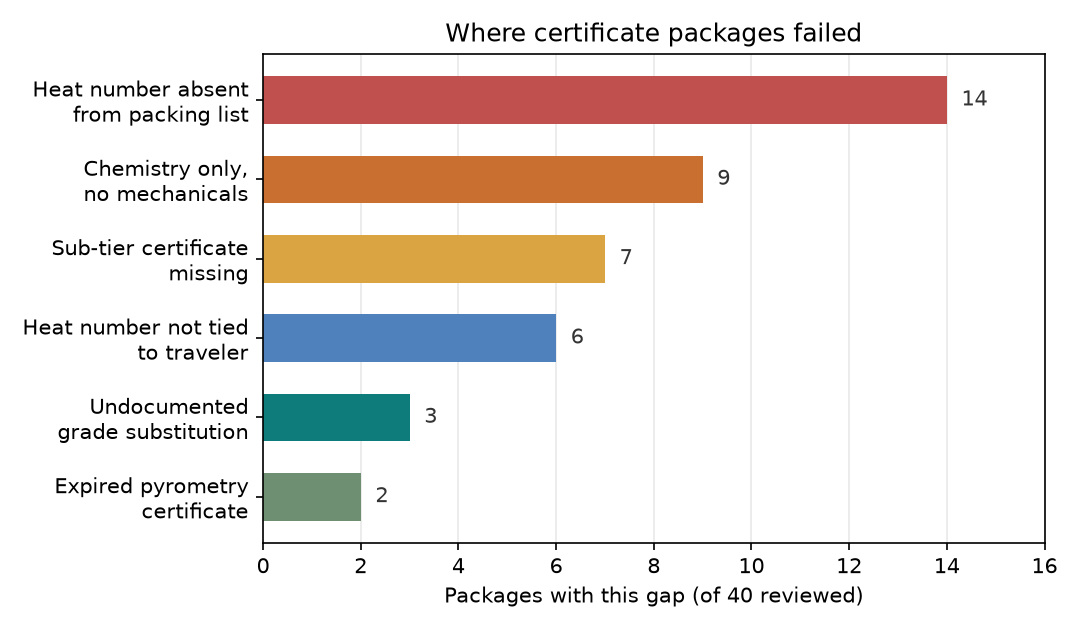
Fourteen carried a certificate with a heat number that never appeared on the packing list. That breaks the chain at the last step and costs almost nothing to prevent. Nine reported chemistry without mechanicals, which says the alloy is roughly right and nothing about how the heat was processed. Seven had no certificate for a subcontracted heat treat or passivation step.
One still bothers me. A bin of 60 stainless brackets held two heats. Both were 316L, both certificates valid, nobody dishonest. An operator topped up the bin from a second bundle at shift change. We sorted the parts by heat with a handheld XRF and relabeled everything, half a day that a second bin would have avoided.
Heat lot segregation is a physical rule, not paperwork: one heat per container, a tag on every remnant, a hard stop when the container runs low.
The document package to demand
A complete package for a 15-5PH machined fitting runs about 14 pages. What belongs in it, in the order I check:
- Mill certificate to EN 10204 3.1 or 3.2, naming the heat, the melt source and the specification tested against, such as AMS 5659 or AMS 4911.
- Chemistry with actual values against spec limits, not a statement of conformity.
- Mechanical results from a test bar tied to the same heat: tensile, yield, elongation, reduction of area, hardness.
- Heat treat certificate with the AMS 2750 furnace class, the cycle, and a chart carrying the load identifier.
- NDT report with the method, acceptance standard, and the technician's NAS 410 level and certificate number.
- Dimensional report from a calibrated CMM, plus AS9102 first article inspection on a new part or changed process.
- Certificate of conformity signed and dated, referencing the documents above by number.
- DFARS specialty metals statement naming country of melt, when the contract flows it down.
Ask for searchable PDFs, because you will search 40 of them for one heat number someday. And ask for the package within five working days of shipment, with the invoice held until it arrives. A supplier who cannot produce documents on that schedule will not move faster during an escape.
I wrote a separate walkthrough on reading a 316L material certificate for chemistry, and one on verifying dimensional inspection reports for measurement.
Purchase order language that works
Traceability fails when it lives in an email. Put it in the PO as numbered clauses, specific enough that a planner on the night shift can follow them without calling sales.
- Each line item ships from a single heat lot unless this PO lists approved multiple heats.
- No change of alloy, grade, melt source or heat without written approval before shipment.
- The heat number appears on every unit pack label, bundle tag and the packing list, in the same format as the mill certificate.
- Certificate package within five working days of shipment as searchable PDF, invoice not payable until accepted.
- Records retained eleven years, produced within two working days on request; sub-tier certificates available on request.
Clause three is the one buyers skip and the one that saves most time. If the label and the certificate format the same heat differently, someone will transcribe a digit wrong at 2 am and the lot becomes suspect.
On a program with a PPAP flow down, these clauses sit next to the submission requirements. Our PPAP submission checklist covers the overlap, and first article inspection is where the chain gets its first real test.
Single heat lot and its premium
A single heat lot costs more. The mill sells in bundle quantities, so a small order needs material pulled from stock already set aside, and the service center charges for the split. One heat also means one setup sequence with no re-verification between bundles.
The premium I see runs 4 to 9 percent on material, nearer 2 to 4 percent on finished part price. Real money on 5,000 pieces, cheap against a lot rejection.
Where I insist: anything with a fatigue note, anything fracture critical, anything serialized, and anything where the customer plans to test a sample and extend the result across the lot. A test bar represents its own heat. Mix three heats and the result covers a third of the shipment.
Where I do not: cable clamps, covers, non structural brackets, prototype hardware. Mixed heats are fine there if the certificate lists every heat and the parts stay segregated with matching labels.
A Ti-6Al-4V forging carries a longer chain than a 316L bracket, and titanium scrap is worth recovering, so segregation pays twice.
Sub-tier processes are the weak link
Most packages I reject fail at a subcontractor, not at the machine shop. Heat treat is the usual culprit. Parts go out for aging, come back with a certificate naming the load but not the heat, and the chain ends.
Three things to ask on any heat treat flow down. The furnace class under AMS 2750, because class 2 holds plus or minus 5 degrees F at the test location and class 5 does not. A chart with the load identifier matching your traveler. Nadcap accreditation, which most primes accept without their own audit.
Passivation follows AMS 2700, anodize MIL-A-8625, and NDT technicians hold NAS 410 level II or III in the method. When a supplier says the sub-tier certificates live at the subcontractor's office, I treat the lot as untraceable.
I lost three weeks on this in 2023. A passivation house in Jiangsu changed its own load numbering and could not map its certificate back to our traveler. The parts were fine, the paperwork was not, and the customer would not accept them. Our quality system now holds sub-tier certificates before parts move, and the how we work page describes the sequence.
What it costs, and when it pays
Here is the arithmetic on a 15-5PH fitting, 250 pieces, machined on a CNC cell for an aerospace customer. Base price is 42.00 dollars. A basic package with a 3.1 certificate and the heat number on the label adds 1.50. A single heat lot with the full sub-tier chain adds 3.20. Serialized marking and eleven year retention take it to 4.80.
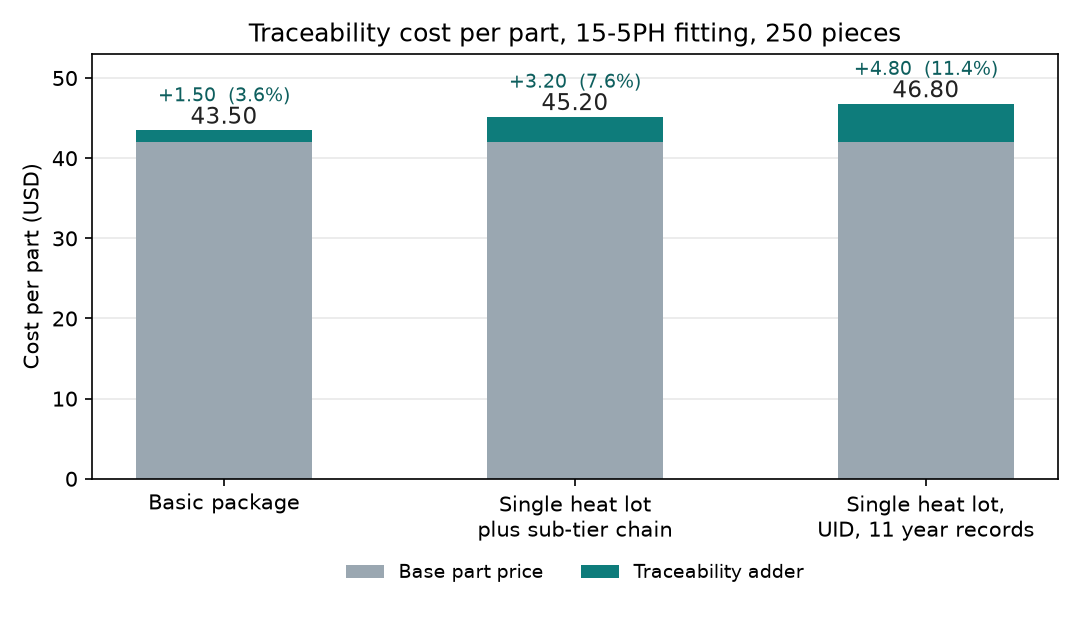
That is 43.50, 45.20 and 46.80 dollars per part, or 3.6, 7.6 and 11.4 percent. Across 250 pieces the spread between the cheapest and the most documented option is 800 dollars.
Price the failure. One rejected lot is 10,500 dollars of scrap, a containment sort near 3,200, and the schedule. The 800 dollar premium pays for itself if it prevents one rejection in seventeen lots. I have never run a program where rejection on untraceable lots was that rare.
Below about 50 pieces the paperwork is fixed cost and the percentage looks ugly, which is why prototype lots often ship with a basic package and a written note about the limitation. Above 500 pieces the adder flattens. If the process is still open, molding changes the material form and sometimes shortens the chain, though the certificate requirements do not move.
Frequently asked questions
These come up in almost every aerospace sourcing conversation. The rest are on our FAQ page.
What is the difference between EN 10204 3.1 and 3.2 certificates?
A 3.1 certificate is signed by the mill's own independent quality department and reports chemistry plus mechanical results for the heat. A 3.2 certificate adds a third party inspector who witnesses the testing and signs the same document. Type 3.1 covers most bracket work; flight critical forgings usually call out 3.2.
How much does material traceability add to cost per part?
On a 42.00 dollar machined fitting at 250 pieces, a basic certificate package adds about 1.50 dollars per part, a single heat lot with the full sub-tier chain adds 3.20, and serialized marking with eleven year retention adds 4.80. That is 3.6 to 11.4 percent of part price.
Do I need a single heat lot for aerospace parts?
Structural parts and anything with a fatigue or fracture critical note should ship from one heat. The premium runs 4 to 9 percent on material. Covers, non structural brackets and prototype hardware can mix heats if the certificate lists every heat number and the parts stay segregated.
How long must aerospace material records be kept?
AS9100 expects records for at least seven years unless the contract says otherwise. Engine and flight control programs commonly flow down eleven years, and some OEMs ask for the life of the program plus ten. Write the number into the purchase order, because retention is a cost the supplier has to price.
Can a supplier substitute an equivalent alloy grade?
Only with your written approval. 303 stainless is not a drop in for 316L, and a 17-4PH heat at H1150 does not behave like H900. Require written approval for any grade, melt source or heat change, and require the deviation to appear on the certificate package.
Need Precision Metal Parts for Your Project?
Yujiaxin Tech specializes in MIM, CNC Machining, Powder Metallurgy, Investment Casting, and Gear Hobbing. Get a free quote within 24 hours.