I have quoted machined parts since 1998, and secondary operations are where most buyers leave money on the table. The cutting gets all the attention. A buyer will argue for a week over ten cents of cycle time, then accept a deburring and finishing plan that quietly adds a dollar a part. I stopped quoting that way years ago.
On a typical 500 piece order of aluminum brackets, secondary work runs 15 to 25 percent of the unit cost. The second pass through the shop costs more than buyers expect, and much of it is avoidable. Here is how I attack it, in the order that saves the most.
- What counts as a secondary operation
- Where the money actually goes
- Consolidate features into the first setup
- Batching and workholding decisions
- Design the part for clamping and access
- Question whether every operation is needed
- Outsource, in house, or consolidate
- FAQ
What counts as a secondary operation
Anything that touches the part after the primary cutting cycle qualifies. Deburring. Heat treatment. Plating, anodizing, passivation, powder coating. Grinding a bore back to size after hardening. Laser marking a part number. Extra inspection beyond standard sampling, assembly, and custom packaging count too. Most of these steps carry their own setup fee, their own inspection burden, and their own chance to scrap the part.
That last point matters more than the price tag. A part that survives machining at 99 percent yield can drop to 95 once it passes through four more hands. I treat each additional operation as a purchase, and if I cannot name what it prevents, it goes back to the drawing.
Process choice sets the size of the secondary bill before anyone talks about saving on it. A metal injection molding part arrives nearly finished, with sintering replacing a heat treat step, so its secondary list is short. A precision casting needs gate removal, weld repair inspection, and straightening before machining, so its list is long.
Where the money actually goes
Bench time and handling dominate, not process chemistry. A deburr station bills at 25 to 45 dollars an hour, and the operator spends more time loading, unloading, and checking than brushing edges. Finishing works the same way: an anodizer charges a batch minimum of 90 to 150 dollars whether the rack holds 40 parts or 400, and over a small lot that minimum swamps the chemical cost per part.
Figure 1 shows how this lands on three part types we quote often. The aluminum 6061 bracket carries 24 percent of its unit cost in secondary work, mostly because the part itself is cheap while the deburr and anodize fees are fixed in size. The 316L housing and the Ti-6Al-4V medical part look better proportionally, yet their absolute secondary cost per part is higher.
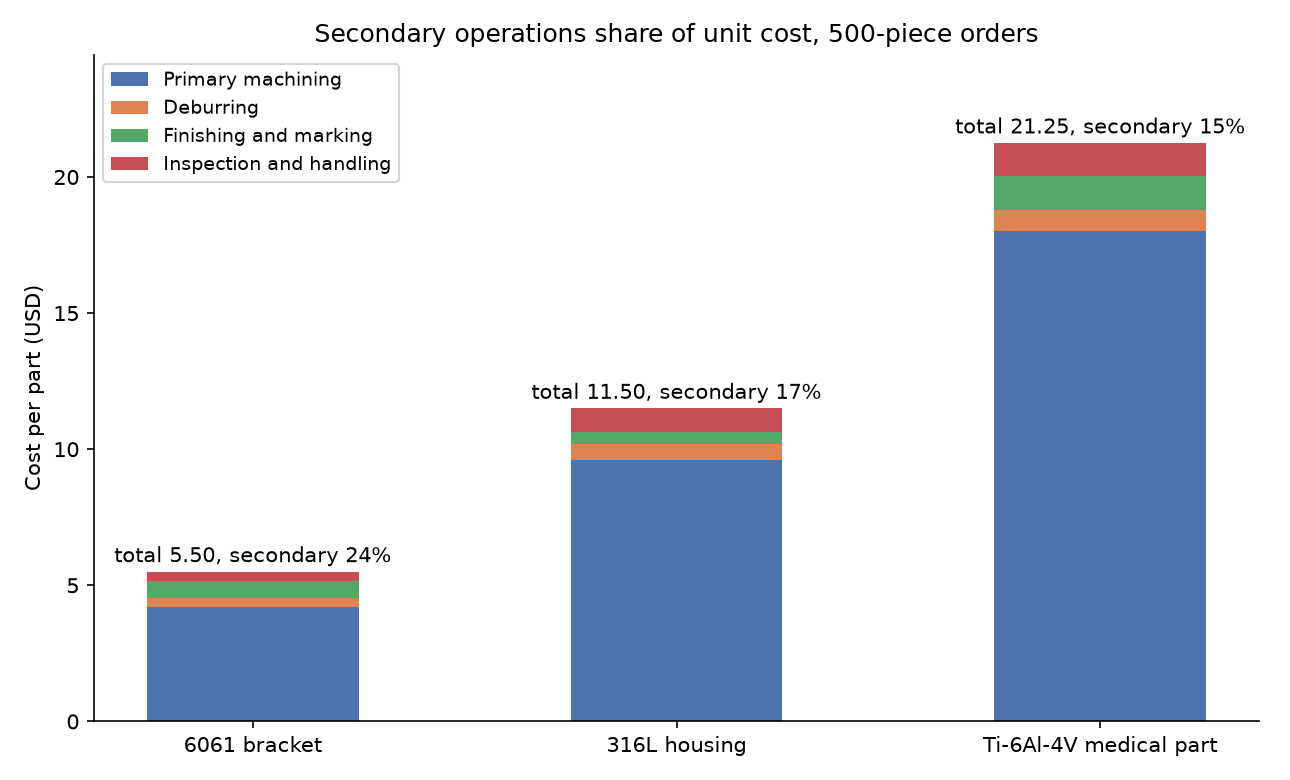
The numbers behind the figure match the way I quote. The 6061 bracket: 4.20 dollars primary machining, 0.35 deburr, 0.60 anodize, 0.25 inspection, 0.10 handling, 5.50 total. The 316L housing: 9.60 primary, 0.60 deburr, 0.45 passivation, 0.70 extra CMM, 0.15 handling, 11.50 total. The Ti-6Al-4V part: 18.00 primary, 0.80 deburr, 0.35 laser marking, 0.90 clean and pack, 1.20 full CMM, 21.25 total. When a buyer asks me where the savings live, that 1.30 dollar line on the cheap bracket is the first place I look.
Consolidate features into the first setup
Every flip of the part is money. A second setup on a three axis mill runs 140 to 220 dollars once you count fixture building, first article checks, and programming touch. My favorite fix is unglamorous: read the drawing and ask whether each feature could be produced in the first clamp.
Examples that recur every month. Chamfers instead of corner radii, so one spot drill covers them. One hole diameter instead of three, so one tool handles the lot. Threads on one face only, so the part never flips. ISO 2768 m tolerances everywhere except the two datum bores that need plus or minus 0.02 mm. None of these changes touch function. All of them delete setups, and a deleted setup is the cheapest secondary operation there is.
I once cut 0.90 dollars a part off a 316L manifold by moving a cross hole 4 mm so a drill could reach it in the main clamp instead of a second angular setup. The customer's engineer pushed back for two days, checked the clearance to the adjacent port, found it fine, and approved. Ask, verify, save. Our guides on features that force 5 axis machining and cost reduction design tips collect more of these moves.
Batching and workholding decisions
Setup fees amortize, and the math is not subtle. A 180 dollar secondary operation setup fee spread over 50 pieces adds 3.60 dollars per part. The same setup over 500 pieces adds 0.36. Over 2,000 it disappears into rounding. If your volumes allow it, batch the secondary work instead of trickling parts through, and negotiate the finisher's batch minimum at order time.
Workholding deserves its own budget line. A dedicated soft jaw or fixture for a running job costs 400 to 800 dollars, whether cut from aluminum or ground from tool steel M2, and it can cut per part handling from four minutes to one. At a 40 dollar an hour secondary station rate, three saved minutes is 2.00 dollars a part, so the fixture pays for itself around part 300. I have bought fixtures that earned out in a single order.
One caution from experience: batching raises inventory. If the design might change, do not push 2,000 parts through deburr to save setup money and then rework 1,800 after an engineering change.
Design the part for clamping and access
Some of the cheapest savings never reach a cost sheet because they happen at the drawing stage. Leave a 3 mm flat pad where vise jaws can grip. Give rotary deburr tools a path into pockets; anything under 5 mm wide may need hand deburring at 0.40 dollars a part or more. Specify an edge break of 0.2 to 0.5 mm instead of "remove all burrs", which is an invitation to inspect every edge by eye and bill you for it. Our deburring specification guide shows the callout language for this.
Surface callouts work the same way. Ra 1.6 on a non-sealing face can drag in a grinding operation at 1.20 dollars per part, where Ra 3.2 as-machined usually does the same job on aluminum 6061. I walked through the drawing side of this in our surface roughness callout guide. If a finish is in doubt, have the shop quote the part both ways.
Question whether every operation is needed
Drawings inherit requirements. A part gets passivated because the previous part was passivated, and nobody remembers why. Passivation on a 316L electronics enclosure that lives indoors buys little; the alloy already resists corrosion well enough for that service, and the acid bath adds 0.45 dollars a part plus queue time. The 316L material page covers where the alloy stands on its own.
Salt spray claims deserve the same scrutiny. An outdoor automotive bracket that must survive 336 hours of ASTM B117 testing needs real coating. An internal sensor housing does not, and quoting it with a 336 hour spec adds maybe 0.30 dollars a part for nothing. I ask one question at every drawing review: what failure does this operation prevent? If the answer is silence, the operation goes. Our guide to plating options and our anodizing versus powder coating comparison list the corrosion hours each finish delivers.
Outsource, in house, or consolidate
Buyers often assume an outsourced secondary operation is always cheaper because specialists specialize. Sometimes. An outside anodizer runs 0.40 to 0.90 dollars per part at volume, but adds a batch minimum, 3 to 5 days of lead time, and freight both ways. A shop with its own line charges more per part and removes a week from the schedule. Which wins depends on volume and on what a week of lead time is worth to you. It is the same trade-off behind setup fees on small machining jobs.
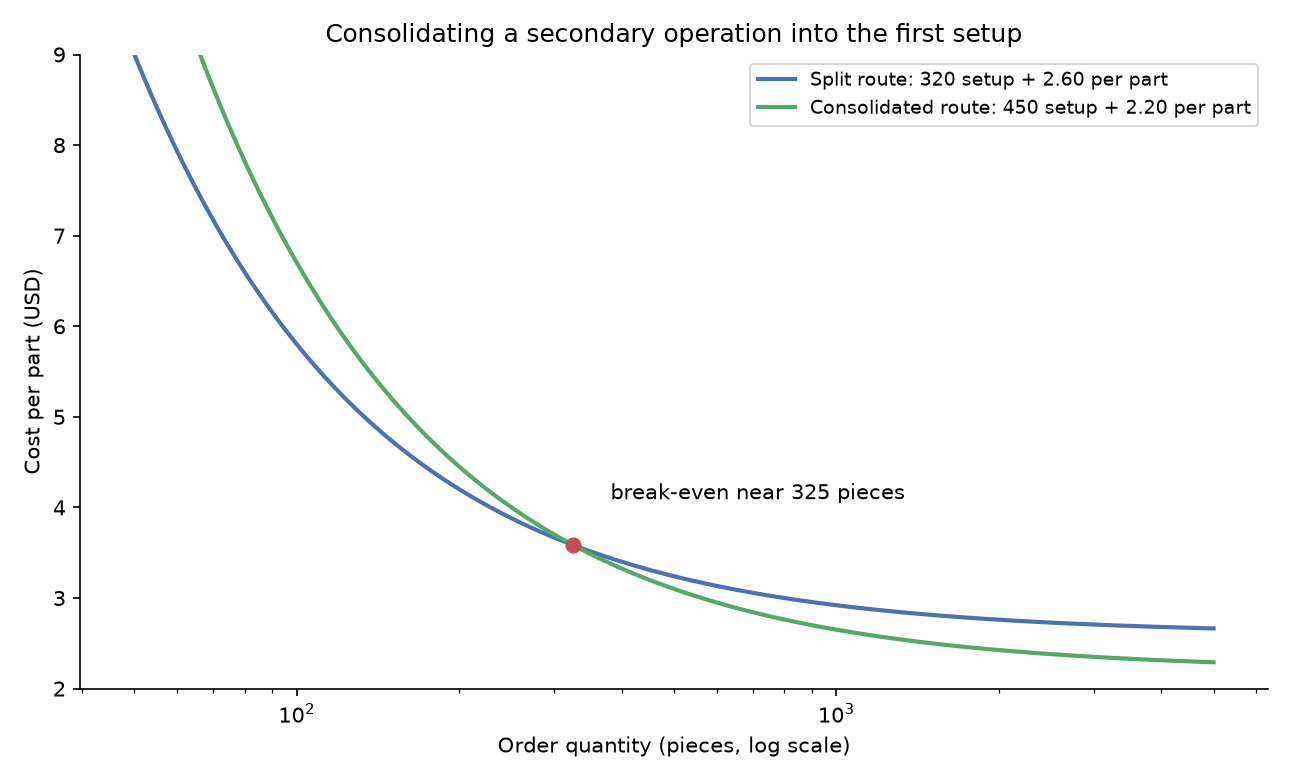
The stronger lever is consolidation, and Figure 2 shows why. Splitting the work across two setups, with 180 and 140 dollar setups and 2.60 dollars per part of run cost, gives 320 dollars fixed plus 2.60 variable. Moving the same work into the primary machine costs a heavier 450 dollar first setup but only 2.20 per part. The lines cross near 325 pieces. Below that break-even volume, the split route is cheaper. Above it, consolidation wins and keeps winning. That crossover is the first calculation I run on any quote with two or more setups.
Volume above roughly 10,000 pieces changes the conversation again. At that scale, molding processes absorb secondary work into the process itself: powder metallurgy sizing can replace hardening steps, as-sintered finishes can replace plating, and the secondary column shrinks. I have moved parts from machined 6061 to PM at 15,000 units purely on this math, and the demand for small, repeatable medical device components follows the same logic.
Gears deserve their own warning. Secondary hobbing, shaving, or bore grinding after near-net forming burns money fast. Matching the gear class, AGMA or DIN, to the actual load instead of copying the old drawing has saved buyers 20 to 30 percent on gear assemblies for me more than once. Our gear hobbing team runs this check before quoting.
If you want to see how inspection fits into this, our quality page describes what gets checked at each stage, how we work walks through the order flow, and the FAQ answers the questions buyers raise before their first order.
FAQ
How much does deburring add to the cost per part?
Vibratory or tumble deburring usually adds 0.10 to 0.25 dollars per part once the batch fills a bowl. Hand deburring runs 0.30 to 0.60 dollars per part and scales with edge complexity. Deep pockets and cross holes push the hand rate higher.
Is anodizing cheaper outsourced or in house?
At low volume, neither is cheap. Outside anodizers charge a batch minimum of 90 to 150 dollars plus 0.40 to 0.90 per part, and add 3 to 5 days of lead time. An in-house line only pays off above sustained volumes in the tens of thousands. Most buyers save real money by batching anodize monthly instead of weekly.
What secondary operations can design changes eliminate?
The big four are second setups, hand deburring, grinding, and separate marking. Chamfers replace deburr-intensive radii, one hole diameter replaces three tools, tolerances relaxed to ISO 2768 m remove grinding, and features moved into the first clamp remove the second setup. On complex parts I have seen these changes remove 20 to 30 percent of unit cost.
How do I know if a secondary operation is worth its setup fee?
Divide the setup fee by the order quantity and add the per part cost. If that total exceeds the value of the function the operation provides, cut it or batch bigger. A 180 dollar setup on 50 parts is 3.60 per part before a tool touches metal; on 2,000 parts it is 0.09 and rarely worth arguing about.
Can plating or heat treatment affect machined tolerances?
Yes. Zinc plating grows surfaces by roughly 5 to 8 microns per side, hard chrome builds 0.05 to 0.15 mm, and case hardening distorts thin sections enough to close bores by several hundredths of a millimeter. Mask or pre-compensate critical dimensions, and never let the plating bath be the first inspector of your tightest tolerance.
Need Precision Metal Parts for Your Project?
Yujiaxin Tech specializes in MIM, CNC Machining, Powder Metallurgy, Investment Casting, and Gear Hobbing. Get a free quote within 24 hours.