Freight is the part of a precision parts order nobody budgets properly. I watched a buyer spend three weeks negotiating 40 cents off the unit price of a CNC machined bracket, then pay $740 to move 20 kg of them across an ocean because nobody had checked the carton dimensions. The trip cost more than the metal.
Small orders get punished because freight pricing carries fixed costs that do not shrink with quantity. A courier bills a minimum before your box leaves the dock. Air freight has a chargeable weight floor at 45 kg. Sea freight has a 1 cubic metre minimum plus destination fees that stay flat whether you ship one carton or forty. Order 100 pieces and those fixed costs land on 100 parts instead of 5,000. The fixes come before the parts are finished: carton size, merged orders, and the Incoterm. For duty on top of freight, see our landed cost guide.
Contents
- What a 20 kg box actually costs to move
- Chargeable weight decides the freight bill
- Pack the carton around the part
- Choosing between courier, air freight and sea LCL
- Consolidating orders beats shipping them one at a time
- Incoterms decide who pays for the expensive parts
- Documents that hold small shipments at customs
- Shipping around the Chinese holiday calendar
- FAQ on small volume machined parts shipping
What a 20 kg box actually costs to move
Take an order I priced last month: 20 machined 316L brackets at 0.35 kg each in one carton measuring 40 x 30 x 20 cm. Gross weight with foam is 8 kg, and the box occupies 0.024 cubic metres.
Run that carton through three modes:
- Courier: 8 kg chargeable at $11 per kg plus $18 for pickup. $106, three to eight days.
- Air freight: below the 45 kg minimum, so it bills at 45 kg at $9 per kg. Add $85 of airline terminal handling and $60 of origin documentation. $550, seven to fifteen days.
- Sea LCL: 0.024 cubic metres rounds up to the 1 cubic metre minimum. Freight is $95 and the fixed side hurts: $180 origin handling, $350 destination terminal handling, $160 deconsolidation. $785, plus 25 to 45 days afloat and three to seven more to unpack.
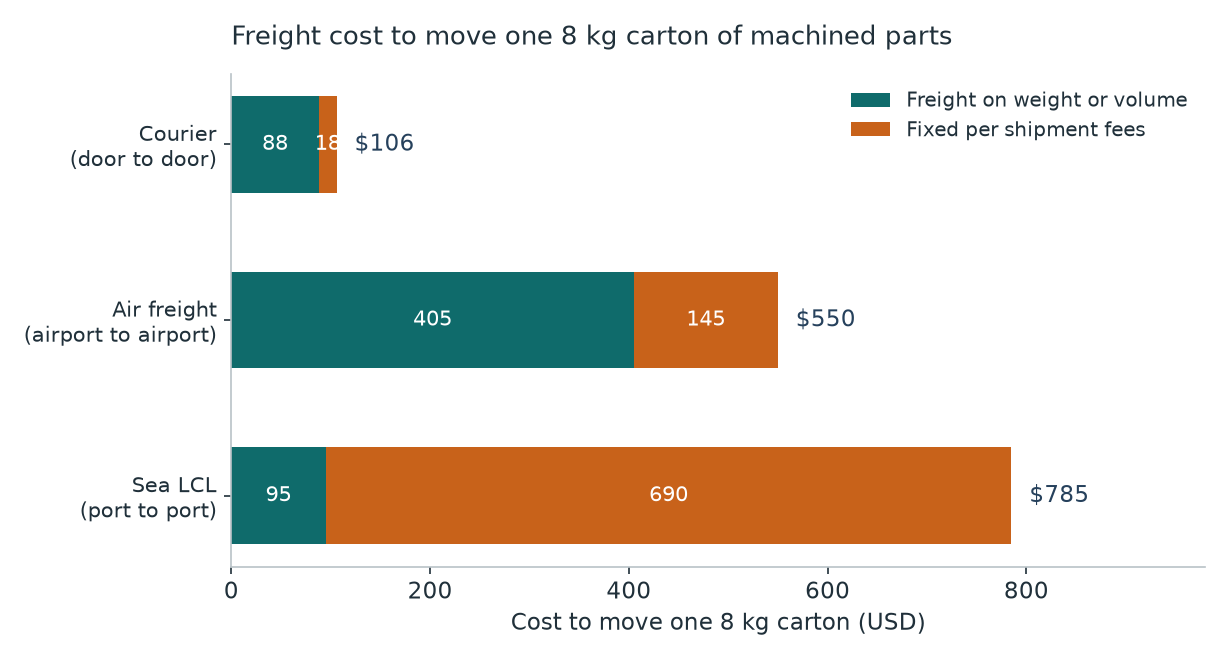
The ocean route costs 7.4 times the courier and takes five weeks longer. I would not ship one carton of machined parts by sea.
Chargeable weight decides the freight bill
Every air quote prices on chargeable weight, the larger of actual gross weight and volumetric weight. Volumetric weight is length times width times height in centimetres divided by a divisor: 5,000 for most couriers, 6,000 for airline cargo. One cubic metre is 200 kg on a courier waybill and 167 kg on an airline one.
Dense parts come out ahead. Steel sits at 7.85 grams per cubic centimetre and aluminum at 2.70, so solid machined parts nearly always bill on actual weight. Finned 6061 heat sinks I sent to an electronics customer last spring broke the rule: the carton measured 60 x 40 x 40 cm and weighed 11 kg. Volumetric came out at 19.2 kg, the courier rounded it to 20, and I paid for 9 kg of air around parts made of 6061 aluminum. Work out both numbers before you ask for a quote.
Pack the carton around the part
Cartons come in stock sizes and packers reach for the nearest one that fits. On the courier divisor, cutting one side of a 60 x 50 x 40 cm carton down to 50 cm takes the volumetric figure from 24 kg to 20 kg. On the airline divisor the same change takes it from 20 kg to 16.7 kg. When your parts bill on actual weight, none of this matters. When you ship thin wall cast housings or heat sinks, it is the cheapest money you will save all year.
Do not shrink the box by removing protection. Machined parts shipped loose rub against each other and 316L galls when it does. Corrosion is the other half: ocean containers sit in high humidity for 30 days or longer, and bare steel arrives with bloom on it. VCI paper inside a sealed poly bag with a desiccant runs $0.10 to $0.30 per part. Our page on stainless steel 316L covers what the grade survives on its own.
Choosing between courier, air freight and sea LCL
Once you have the chargeable weight and the cubic metres, the mode usually picks itself:
- Under 30 kg: courier. One tracking number covers pickup through delivery, and clearance runs inside the courier's own brokerage.
- 30 to 45 kg: still courier on most lanes, because below the air freight minimum you pay the worst tier anyway.
- 45 to 500 kg: air freight. Rates step down at 100 kg, 300 kg and 500 kg, so quoting at 290 kg when you need 300 leaves money on the table.
- Above 1 to 2 cubic metres: sea LCL. Above about 10 cubic metres, ask for a full container quote as well.
Density moves those lines. Anything above 167 kg per cubic metre favors the ocean at lower volumes, because volume based pricing stops punishing you. Anything below 100 kg per cubic metre gets billed hard on space. People forget one more option: split it. Fly 15 to 20 percent of the order and ship the rest by sea. The FAQ covers the buyer side of this.
Consolidating orders beats shipping them one at a time
Here is where the real money is. That 0.35 kg bracket packs 20 to a carton, 0.4 kg gross per part. Ship 100 once a month for a year and the LCL fixed cost stack hits you twelve times, twelve bills near $785, or $7.85 per part. Ship 1,000 at once and the bill is $804, or $0.80 per part.
The courier line barely moves, because a kilogram is a kilogram at 100 or 5,000. Across the same range the courier cost per part goes from $3.86 to $2.92, air freight falls from $5.50 to $2.27, and sea LCL falls from $7.85 to $0.25, passing the courier between 100 and 250 parts.
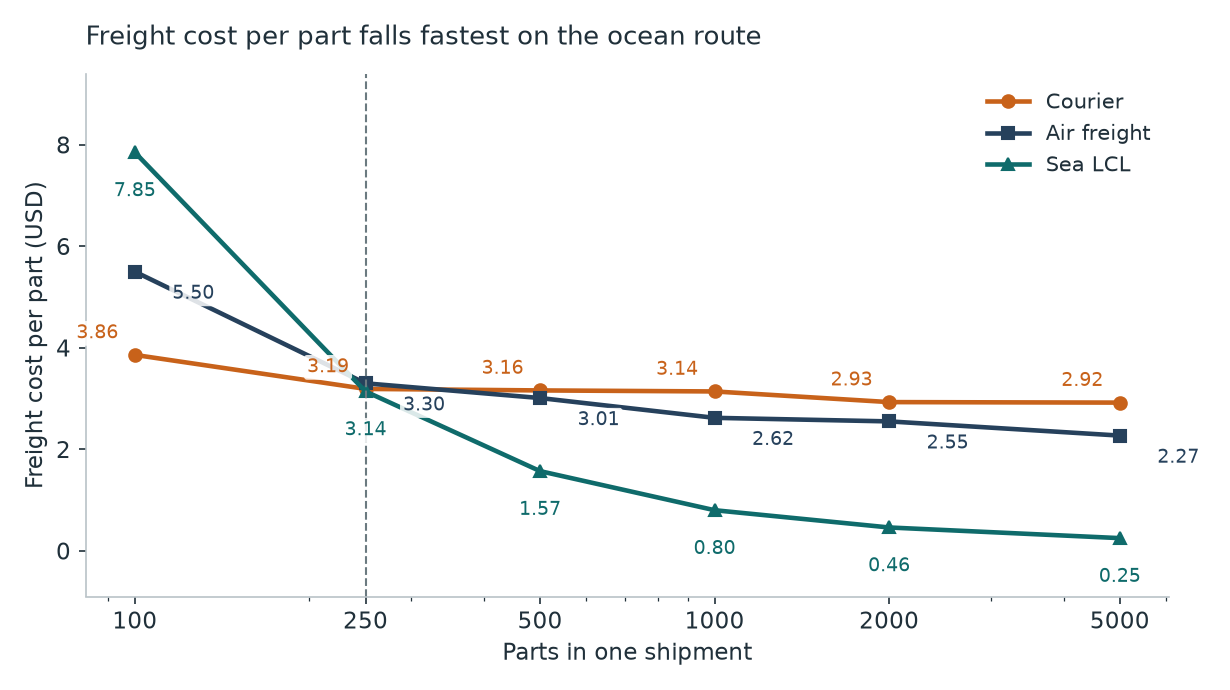
Put every part number heading to the same address on the same booking and batch the releases. A buyer I work with moved from a 200 piece monthly release to a 600 piece quarterly one, same annual volume, and freight per part fell from $3.93 to $1.31, a 67 percent cut. Weekly releases are normal in automotive programs and are the most expensive way to buy freight I know of. Consolidating two machined pieces into one net shape part works the same way, and we quote powder metallurgy, metal injection molding or batched gear hobbing instead of long machining cycles.
Incoterms decide who pays for the expensive parts
The Incoterm on your order decides who owns the fixed costs above. Under EXW you own all of them, including export clearance in China, which the factory still has to help with. Under FOB the goods pass at the ship's rail, which is useless for air freight. FCA is the version that works for air: the seller hands the goods to your forwarder.
DDP and DAP look easy because one number covers everything. I read the line items instead, and I have seen destination charges inside a DDP quote come in 20 to 40 percent above what my own broker charges for the same work, because the forwarder takes margin on services you never see. With a broker and a bond, ship FCA or FOB and control the destination yourself; see our note on reading a machining quote. Cargo insurance at 0.3 to 0.5 percent of value is $24 to $40 on $8,000 of parts. Our how we work page lists the terms we ship on.
Documents that hold small shipments at customs
Small shipments get examined more often than people expect, and nearly every delay I have dealt with traced back to paperwork. Three items matter. A commercial invoice with a realistic value, the country of origin and the HS code, because undervaluing to save duty is the fastest route to an exam. HS classification: finished steel parts usually fall under heading 7326 and aluminum fabrications under 7616, but the last digits depend on the importing country, so give your broker the drawing. And wood packaging: any solid wood pallet needs the ISPM 15 stamp or the shipment can be refused.
A mill certificate ties the heat number on the invoice to a physical batch, and customs officers ask for it routinely on medical and aerospace programs. Our quality page and inspection checklist show what ships with the goods. Why this matters in dollars: an exam burns your free time at the port, and US terminals often allow four to five days before demurrage starts at $150 to $400 per day.
Shipping around the Chinese holiday calendar
Freight pricing is seasonal and small shippers feel it hardest. Ocean carriers add peak season surcharges of $500 to $2,000 per container between August and October, and air rates climb 30 to 60 percent before Black Friday. Factories close two to four weeks around Chinese New Year and a week at Golden Week, with bookings filling two to three weeks ahead.
Anything landing in Q4 goes on a vessel in July. Anything needed after mid January ships by mid December or waits until March. Price the air option at the same time as the sea option. Our notes on cutting lead time and on prototype to production start from the same calendar.
FAQ on small volume machined parts shipping
What is the cheapest way to ship 50 machined parts from China?
A courier on most lanes. Fifty 0.35 kg brackets weigh about 20 kg gross and fit one carton: roughly $238 at $11 per kg plus $18 in fees, three to eight days. Air freight bills the 45 kg minimum and sea LCL the 1 cubic metre minimum, and both land above $500 once fixed fees are added.
How do I calculate chargeable weight for machined parts?
Take actual gross weight, then volumetric weight: length times width times height in centimetres divided by 5,000 for couriers and 6,000 for airline cargo. Bill on the larger. Solid steel and aluminum parts usually bill on actual weight. Thin wall housings, heat sinks and covers often bill on volume.
Is sea freight worth it for small volume machined parts?
Below about 1 cubic metre, no. A 0.12 cubic metre shipment still pays the 1 cubic metre freight minimum plus roughly $690 of origin, terminal and deconsolidation fees: $785, against $106 for the same carton by courier. Sea starts winning once one shipment passes roughly 250 pieces.
Can I combine several part numbers into one shipment?
Yes. Multiple part numbers on one invoice are normal as long as each line carries its own description, value and HS code. Consolidating a 200 piece monthly release into a 600 piece quarterly one took freight from $3.93 to $1.31 per part.
Do Incoterms change my freight cost per part?
They change who pays the fixed fees, and fixed fees are where small shipments hurt. Under EXW you own origin pickup, export clearance and every destination charge. Under FCA the seller hands the goods to your forwarder at a named place. DDP bundles everything into one number, and the destination line items inside it often carry 20 to 40 percent of forwarder margin.
Measure the carton, work out the chargeable weight, batch the orders, and read the fixed fee lines. Freight is the one cost on a small parts order you can halve without asking anybody for a discount.
Need Precision Metal Parts for Your Project?
Yujiaxin Tech specializes in MIM, CNC Machining, Powder Metallurgy, Investment Casting, and Gear Hobbing. Get a free quote within 24 hours.