Most sourcing arguments I sit in on are not about price. They are about who pays the forwarder at the destination port, and who learns four weeks later that duty was charged on the wrong value. Both answers sit in the Incoterm field of the purchase order.
I have bought metal parts from Chinese shops since 1998 and signed POs under every term in Incoterms 2020. The ones that go wrong are rarely the exotic ones. Two people read the same three letters and picture different obligations.
On this page
- What the term actually decides
- The terms that cover most part shipments
- Delivered cost does not change, the invoice does
- Where risk moves, and what a wet carton costs
- Matching the term to order size
- Mistakes I keep seeing on purchase orders
- How to write the term into the purchase order
- Questions I get asked about Incoterms
What the term actually decides
An Incoterm fixes two things. It splits the cost of moving goods from the factory door to yours, and it marks where risk passes from seller to buyer. Nothing else. Payment terms, title, warranty and product liability sit outside Incoterms 2020, whatever a quotation template implies.
The two things do not travel together. Under CIF, risk passes when the goods are loaded in Shenzhen, while the seller keeps paying freight and insurance to the destination port. For about 30 days the seller is paying for cargo it no longer carries the risk on. Buyers who read "seller pays freight" as "seller carries the risk" learn the difference the first time a container is dropped.
Eleven terms exist. Seven of them, FAS, FOB, CFR, CIF, DAP, DPU and DDP, are written for sea and inland waterway transport. Air freight and courier samples belong under EXW, FCA, CPT or CIP.
The terms that cover most part shipments
| Term | Seller pays to | Risk passes |
|---|---|---|
| EXW | Your factory door, nothing loaded | At the factory, once goods are available |
| FOB | Loaded on the vessel at the named Chinese port | Once goods are on board |
| CIF | Freight and minimum insurance to the destination port | Once goods are on board |
| DAP | Delivered to your address, duty unpaid | At the named place, ready for unloading |
| DDP | Delivered to your address, duty paid | At the named place, ready for unloading |
Five of those cover almost everything I buy. The table is the short version. The long version is a 200 page ICC document I have read twice and still check before a difficult shipment.
For containerised cargo FCA is technically correct, because FOB assumes goods cross a ship's rail and a container in a terminal left the seller's control days earlier. I still write FOB on most POs. Every forwarder in Shenzhen understands it, and the hours spent converting a sales team buy me nothing on a 40,000 dollar order. I insist on FCA only when the supplier delivers into a consolidation warehouse, which is the gap FOB leaves open.
None of these letters touch quality. A full dimensional report or a sample plan is set by the drawing and the PO spec. What inspection covers is on the quality page, and the sequence from drawing release to booked freight is in how we work.
Delivered cost does not change, the invoice does
Take a job I quoted last spring: 6,000 machined 316L sensor housings, 1,180 kg gross, 2.4 cubic metres, 37,200 dollars ex works Shenzhen, destination Hamburg, duty 2.7 percent. Machining on a CNC machining line leaves a lot of air in a carton, and freight is charged on volume.
Freight is LCL at 118 dollars per cubic metre, so 285. Export trucking and declaration 240. Marine insurance at 0.15 percent of CIF plus ten percent is 62. Destination handling and documents 210, clearance 130, last mile 260, duty 1,020.
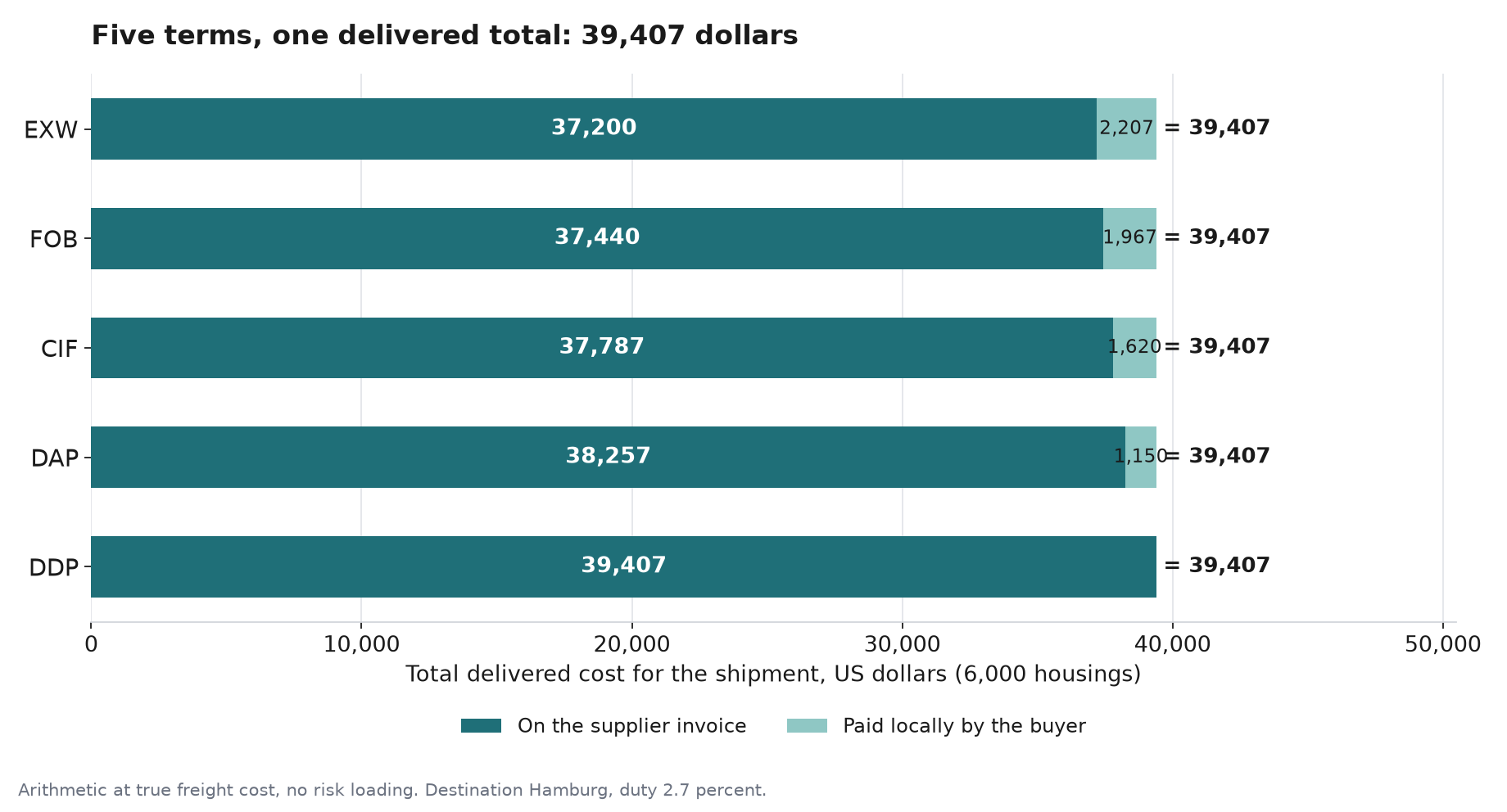
Every line together is 39,407 dollars under all five terms, or 6.57 per housing. The total does not move when the term changes. The invoice does: 37,200 under EXW, 37,440 under FOB, 37,787 under CIF, 38,257 under DAP, 39,407 under DDP. You either wire less and pay locally, or wire more and pay nothing after arrival.
Real DDP quotes carry a risk loading of 3 to 7 percent, and it appears nowhere on the quotation. A supplier pricing DDP at exactly FOB plus freight plus duty is either very confident or very new. I trust the second type less, because the first damaged container teaches them what the loading was for.
The full model, including tooling and inspection, is in calculating landed cost for imported metal parts.
Where risk moves, and what a wet carton costs
CIF insurance is the most misunderstood line in the system. The seller buys cover at 110 percent of value at the minimum Institute Cargo Clauses (C) level. ICC(C) covers total loss, major accidents and a short list of named perils. It excludes water damage from a leaking hatch, condensation inside a container and theft from a terminal.
Last year a buyer I work with opened a container in Rotterdam and found 14 cartons of aluminium brackets in 4 cm of water. Rework came to 6,800 dollars. The CIF policy excluded it because the water came from condensation, not an accident. The claim went to the forwarder, then the terminal, and settled at 31 percent after eleven weeks.
Under DAP and DDP that loss belongs to the seller until the goods are unloaded at your address. You file nothing. The supplier absorbs it and adds 2 to 4 percent to the next quotation. Neither arrangement is more honest. A buyer should know which one is on the table.
For heavy or expensive parts I buy ICC(A) cover myself and price the order FOB. On the 37,200 dollar shipment the premium is about 95 dollars instead of 62. That 33 dollar difference covers water damage, theft and non-delivery, which is cheap next to an eleven week argument over 6,800 dollars.
Matching the term to order size
The term that works at 200 kg is not the term that works at 9 tonnes, because fixed charges do not scale with value.
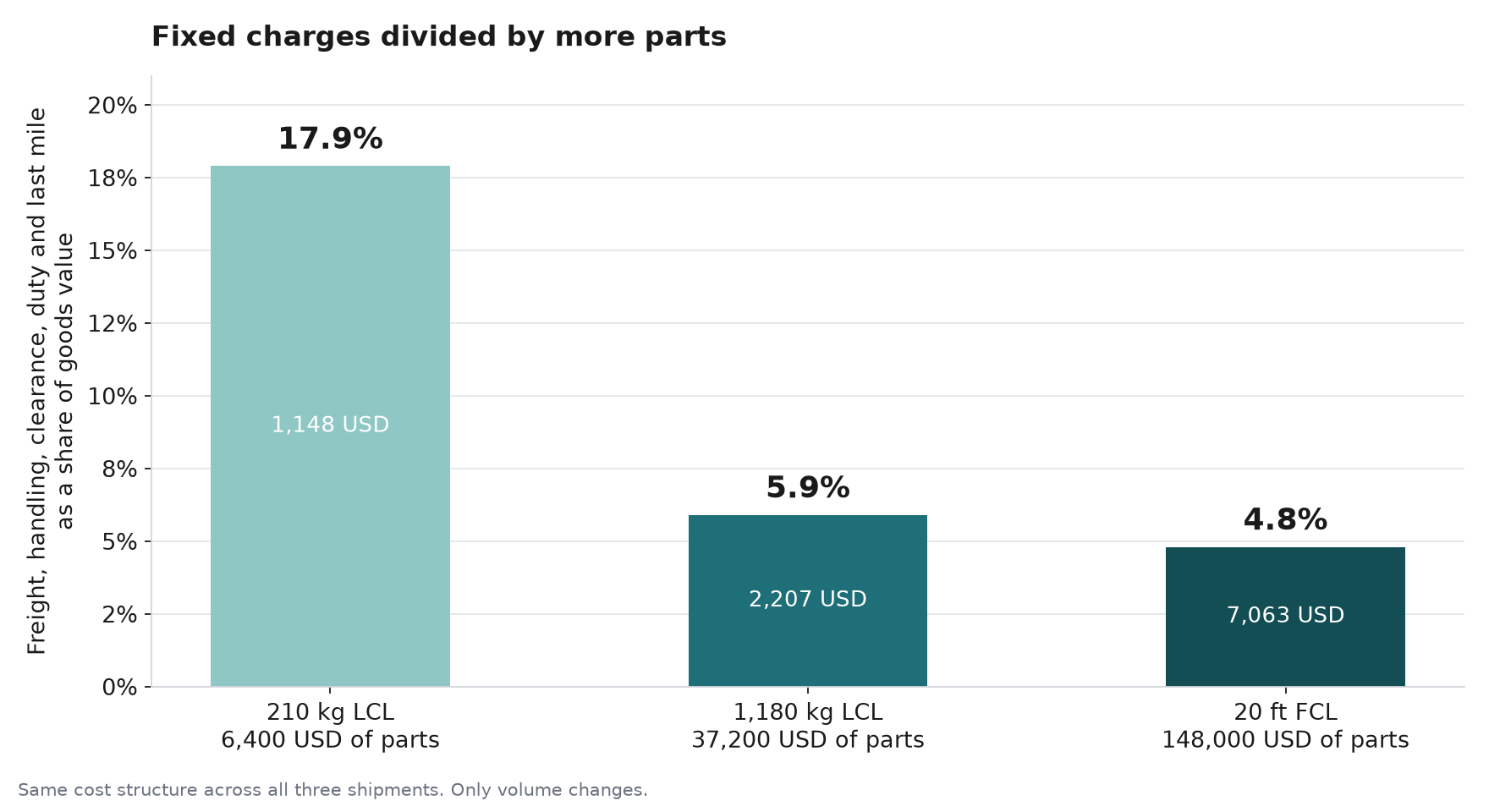
A 210 kg LCL shipment worth 6,400 dollars carries 1,148 dollars of freight, handling, clearance, duty and last mile, which is 17.9 percent of goods value. The 1,180 kg job above carries 2,207 dollars, or 5.9 percent. A 20 foot container holding 148,000 dollars of castings carries 7,063 dollars, or 4.8 percent. The container is not cheaper per kilo because the shipping line likes you. It is cheaper because fixed lines get divided by more parts.
Below about 500 kg I buy FOB and consolidate. Paying a supplier a margin on a 285 dollar freight line also means giving up the forwarder who answers email on a Saturday. The mechanics of that are in shipping small volume machined parts without high freight.
Above 15 tonnes DDP earns its loading, since the loading is a small share of a large invoice and one customs procedure leaves my desk. My own break-even sits near 8,000 dollars of goods value. Below it I want control, above it I want fewer people in the chain.
Castings shift it again. A container of investment cast valve bodies for industrial pump skids weighs over 12 tonnes and is worth less per kilo than machined stainless, so freight and duty reach 8 or 9 percent of value. At that weight the comparison starts to affect which supplier you pick.
Mistakes I keep seeing on purchase orders
The most expensive one is a term with no named place. DAP alone is a wish, not a term. The obligation changes depending on whether the address has a loading dock or is an office where a 40 foot trailer cannot turn.
The second is duty basis. Under DDP the seller clears the goods, so the declared value is whatever the seller declares. I have seen suppliers declare 55 percent of invoice value to cut duty, and buyers congratulate themselves on the saving. The parts are still yours, and an audit that finds the under-declaration finds your part numbers in the file. I write the declared value and the HS code into the PO whenever I accept DDP.
The third is a template that still says CIF Incoterms 2010. The 2020 revision changed insurance requirements and the DPU naming rules. A PO citing 2010 is not fatal, but it tells you nobody has opened the document in six years. Whether the shop can hold the tolerance at all is a separate problem, covered in how to vet a Chinese metal parts manufacturer before ordering.
How to write the term into the purchase order
Write the three letters, the named place and the revision in that order. FOB Shenzhen, Incoterms 2020 is complete. DAP 14 Industrieweg, 3011 AA Rotterdam, Incoterms 2020 is complete. DDP is not.
Then attach the lines Incoterms never covers: who pays pre-shipment inspection, who owns the packaging, what happens to the tooling if the program ends, which documents travel with the goods. I have seen a 22,000 dollar MIM mould sit in a supplier's storage room for two years while two companies argued about ownership.
Use the same wording on the quotation, the PO, the invoice and the packing list. A mismatch is the most common reason a broker holds a shipment for three days, and nobody refunds you those days. Clean documents also explain why some suppliers answer an RFQ in a day, which is half of getting faster quotes from Chinese machining suppliers.
The rest of the shipping questions I get, from certificates of origin to who books the pre-shipment inspection, sit on our FAQ page.
Questions I get asked about Incoterms
Is DDP cheaper than FOB for small orders?
Almost never. Below 500 kg the fixed charges dominate, and a supplier arranging freight, clearance and duty builds a margin into each line. A 210 kg shipment worth 6,400 dollars carries 1,148 dollars of non goods cost, and DDP hides that margin inside one number.
Who pays import duty under DAP?
The buyer does. DAP means the seller delivers to your named place with duty unpaid, so your broker clears the goods and pays duty and VAT. That keeps the customs declaration in your name, where you control the HS code and the declared value instead of trusting a supplier's clerk.
Does CIF insurance cover damage in transit?
Only the perils listed in Institute Cargo Clauses (C), at 110 percent of invoice value. Condensation damage, theft from a terminal and handling damage short of a major accident usually fall outside it. On expensive or easily damaged parts, buy ICC(A) cover and price the order FOB.
Which Incoterm should I use for LCL shipments of machined parts?
FOB, with your own forwarder. LCL cargo is consolidated and handled more times than a full container, so visibility matters more than a bundled price. FOB also keeps the insurance claim and the customs entry in your hands, not with a supplier eight time zones away.
Need Precision Metal Parts for Your Project?
Yujiaxin Tech specializes in MIM, CNC Machining, Powder Metallurgy, Investment Casting, and Gear Hobbing. Get a free quote within 24 hours.