I have quoted the same steel part both ways more times than I can count. A buyer sends a drawing for a small steel component, we run it on CNC machining, volumes grow, and the quote stops making sense. Somewhere past ten thousand units a year, powder metallurgy usually takes the job. The question buyers ask me is simple: where exactly is that point, and what decides it?
The honest answer is that the crossover is not mysterious. It is arithmetic. Tooling cost on one side, per-part machining cost on the other, and a volume where the two lines meet. What people miss is how differently the two processes behave before and after that point. Below I walk through the numbers I use when quoting a powder metallurgy job against CNC, the trade-offs that never show up in a spreadsheet, and the mistakes I have watched buyers make when they switch too early or too late.
In this guide
Where the cost lines cross
Every powder metallurgy quote starts with a number the CNC quote does not have: the tool. A compaction die for a mid-size steel part, say a 60 gram lever or a small rotor, runs about 25,000 dollars in our shop for a single cavity. CNC needs no tool, so its per-part price stays nearly flat across volumes.
Take a real example from last year. A 60 g steel link for an automotive seat adjuster, later carried across three vehicle platforms. On CNC the part quoted at 3.60 dollars per piece at 1,000 units and drifted down to about 3.00 dollars at 100,000 units as setup and programming amortized. In powder metallurgy, the same geometry pressed and sintered came to about 1.15 dollars per piece in powder, press time and sintering, with the 25,000 dollar tool spread over the run.
Do the division and the lines cross somewhere around 12,000 to 13,000 units. Below that, CNC wins on cost per part. Above it, the gap widens fast: at 100,000 units the powder metallurgy part lands near 1.40 dollars against 3.00 dollars for the machined one. That is a 53 percent saving on the largest line item of the program.
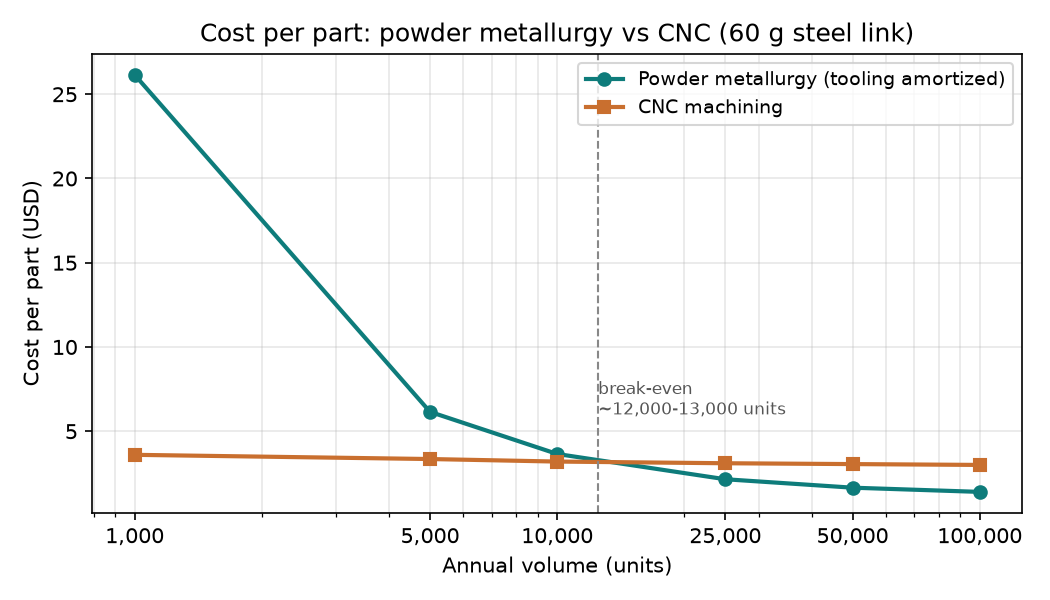
I treat ten thousand units as the practical entry gate for parts in this weight class, and I tell buyers to model their own break-even volume before committing to tooling. The gate moves with part weight, complexity and alloy, but the shape of the curve rarely does.
Material utilization is the quiet advantage
The second advantage hides in the scrap bin. Machining a part from bar stock turns half or more of the metal into chips. On a 60 g part cut from 300 g of bar, roughly 240 g becomes swarf, and the recycler pays a fraction of what you paid for the metal. I have never seen chip resale recover more than a small slice of material cost, even on plain steel.
Powder metallurgy presses near-net shape. Utilization runs around 93 percent in a well-run press shop, and metal injection molding reaches about 95 percent because the sprue and runner recycle straight into the next batch. When the alloy is expensive, the difference is not cosmetic. On sintered 316L stainless parts and on high speed steel grades like M2 tool steel, raw material dominates the price, and throwing away half of it is a cost you pay on every single part.
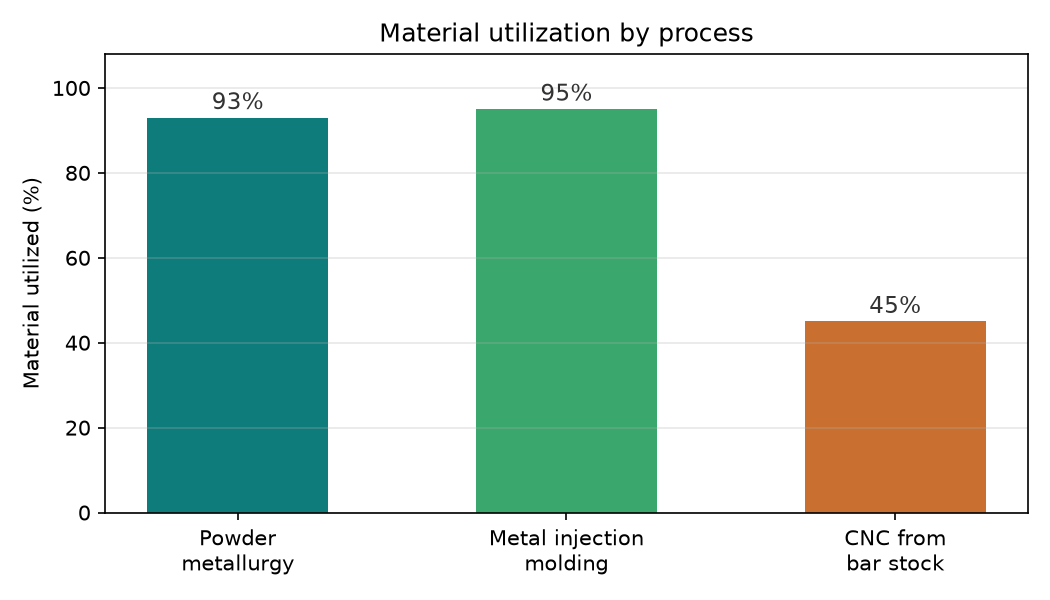
Chips also cost money twice: you paid for the metal, then you pay again to cart them away. A press-and-sinter line produces almost none of that. No chip weight on the freight invoice, no disposal paperwork, no oily swarf sitting in a hopper waiting for the scrap truck.
What powder metallurgy tooling costs
Tooling is where powder metallurgy gets expensive, so it deserves its own math. A single-cavity tool for a simple two-level part runs 18,000 to 30,000 dollars. Multi-level parts with steps, keyways or other complications cost more, sometimes well past 40,000 dollars. Lead time runs four to six weeks for the die set, and a geometry change after the steel is cut means a partial or full re-cut.
I tell every buyer the same thing: freeze the drawing before tooling starts. Changes that look trivial on screen, a boss moved 2 mm or a wall thickened 0.5 mm, can force a new upper punch. Our guide on design changes that reduce cost in powder metallurgy covers the details worth checking before you sign off.
If your part is smaller and more complex than a press tool can handle, metal injection molding is the better fit. MIM tooling suits complex small geometries and holds finer detail, though the powder and sintering economics differ. And if you are weighing a sintered part against a machined one on a corrosion application, we wrote a full comparison of sintered versus machined stainless steel components.
Compaction tool life expectancy
Buyers rarely ask about tool life, and then they get surprised by a re-tooling invoice. A well made compaction tool pressed with plain iron or low alloy steel powder holds up for 100,000 to 500,000 cycles. The spread is wide because powder abrasiveness drives wear. Soft iron powders are gentle on a die. Add hard constituents, or press tool steel powders, and wear accelerates fast.
Ask two questions before you award the job. First, what tool life does the supplier expect on your specific powder mix? Second, who pays when the die wears out mid-program? We size punches and cores so that a refurbish, rather than a re-cut, handles most wear events, and our how we work page describes how tooling maintenance runs across a program. If a supplier cannot answer the first question with a number, I would keep looking.
Tolerances, density and strength trade-offs
Powder metallurgy is precise, but precise in its own way. As-sintered dimensions hold roughly plus or minus 0.1 to 0.3 percent of feature size. A 30 mm diameter comes off the sintering furnace within about 0.03 to 0.09 mm. Where the drawing demands more, a sizing operation tightens critical diameters to around 0.013 mm. CNC, by comparison, holds 0.025 mm on almost any feature without ceremony, as our CNC machining tolerances guide explains. If your print spreads tight tolerances across many features instead of two or three, machining stays the simpler route.
Density is the other trade-off. Pressed and sintered steel parts run 6.8 to 7.2 g/cm3 against 7.85 for wrought material, and the residual porosity lowers fatigue life in a way a machined part never sees. Sizing and heat treatment close part of the gap, and oil impregnation turns porosity into a feature when you want self-lubrication. MIM parts sinter to 96 to 98 percent density and behave closer to wrought material. I have watched engineers chase wrought-equivalent fatigue numbers in pressed parts and burn months doing it. State the real load case up front and pick the process that matches it.
When CNC machining is still the right answer
None of the arithmetic above matters if your volumes are low, your part is large, or your design is still moving. Under roughly five thousand units a year, tooling rarely pays back. Large parts that exceed press tonnage or die size stay machined regardless of volume; press capacity tops out and tool cost climbs with every square centimeter of die area. And if the design will change twice more this quarter, machining absorbs the churn while powder metallurgy punishes it.
Prototypes deserve a separate note. We machine first articles in wrought material, validate function, then cut the press tool. Our guide on choosing a metal parts manufacturing process covers how to sequence that decision. For parts too large or too irregular for either process, investment casting is often the middle ground.
Secondary operations that change the math
The 1.15 dollar per part in my example assumes the part comes off the sintering belt finished. That rarely happens. Sizing adds a press operation. Machining one datum face or drilling a cross hole brings the part back to a CNC cell for a minute or two. Heat treatment, plating and resin impregnation each add their own step. Every operation chips away at the cost advantage that justified the tool in the first place.
My rule: keep secondary operations to one or two, and design around them. Coin the flat instead of machining it. Mold the cross hole if the geometry allows. Specify a self-lubricating density instead of oiling parts downstream. If a quote lists four or five secondary operations, the powder metallurgy advantage is probably gone, and someone should say so before the tool steel is cut.
Frequently asked questions
These are the questions buyers raise most often; our full FAQ page covers the rest.
How much does powder metallurgy tooling cost?
A single-cavity compaction tool for a simple part runs 18,000 to 30,000 dollars in most shops. Multi-level or large-part tools can pass 40,000 dollars. The figure scales with the number of levels, punch complexity and expected tool life on your powder mix.
What is the break-even volume for powder metallurgy versus CNC?
For a 60 g steel part with 25,000 dollars of tooling and about 1.15 dollars per part in press and sinter costs, the break-even volume lands around 12,000 to 13,000 units against a machined part costing near 3.00 to 3.60 dollars each. Heavier or more complex parts push the crossover higher.
How long does a powder metallurgy compaction tool last?
Expect 100,000 to 500,000 compaction cycles depending on powder abrasiveness and tool materials. Ask the supplier for a predicted tool life on your specific mix and a written rework policy before awarding the program.
Can powder metallurgy hold tight tolerances?
As-sintered dimensions hold about plus or minus 0.1 to 0.3 percent of feature size. A sizing operation tightens critical features to roughly 0.013 mm. Across many tight features at once, CNC machining remains the safer choice.
Is a sintered part weaker than a machined one?
Pressed and sintered steel runs 6.8 to 7.2 g/cm3 versus 7.85 for wrought stock, and residual porosity reduces fatigue strength. Sizing, higher press densities and heat treatment narrow the gap for most static applications. MIM parts reach 96 to 98 percent density.
Need Precision Metal Parts for Your Project?
Yujiaxin Tech specializes in MIM, CNC Machining, Powder Metallurgy, Investment Casting, and Gear Hobbing. Get a free quote within 24 hours.