I have quoted stainless steel parts both ways since 1998: cut from wrought bar, and pressed or molded from powder, then sintered. Buyers ask me for the difference as if it were one number. It is four numbers: density, elongation, tolerance, and the volume at which the tool pays for itself.
A 316L bracket machined at 8.00 g/cm³ and the same bracket sintered at 7.10 g/cm³ carry the same alloy name and behave like different materials in a salt chamber. That gap is where most sourcing mistakes start, and it is predictable if you check the right figures before you sign the tooling PO.
- What sintering does to stainless steel
- Density is the number to argue about
- Mechanical properties side by side
- Tolerances and surface finish
- Corrosion behaviour of sintered parts
- Cost per part and break-even volume
- When machining still wins
- How I write the specification
- FAQ
What sintering does to stainless steel
Sintering is not melting. A powder metallurgy shop mixes 316L powder with a small percentage of lubricant, presses the compact in a hardened die at 600 to 700 MPa, and holds it at 1,260 to 1,320°C in a reducing atmosphere until the particles bond by solid state diffusion. Metal injection molding takes a finer powder, near 10 µm, blends it with roughly 40 percent by volume of polymer binder, molds the shape on a standard injection press, removes that binder over 24 to 48 hours, and sinters at 1,350 to 1,380°C.
Both routes leave pores behind. That is the whole story in one sentence. Wrought bar comes from a fully molten heat and carries no porosity to close. A sintered part starts life at around 60 percent of theoretical density in the green state and finishes between 86 and 99 percent, depending on the route and the sintering hold. Everything else in this article follows from that one difference.
Density is the number to argue about
Published data puts pressed and sintered 316L at 6.9 to 7.3 g/cm³ and MIM 316L at 7.7 to 7.9 g/cm³, against 8.00 g/cm³ for wrought material. As a share of theoretical density that is 86 to 91 percent for pressing and 96 to 99 percent for MIM.
I put density in the purchase order before I put the alloy. A drawing that reads "316L" and nothing else lets a supplier ship 6.8 g/cm³ parts that pass a chemistry check and fail a 10 bar leak test the same week. If the part must hold pressure, I write 7.6 g/cm³ minimum and ask for the measured value on the inspection report. The 316L material page lists the grades and conditions we cut and mold from.
Mechanical properties side by side
Wrought 316L in the annealed condition runs about 580 MPa ultimate tensile, 220 MPa yield and 45 percent elongation. Pressed and sintered 316L at 7.1 g/cm³ gives roughly 450 MPa, 160 MPa and 18 percent. MIM 316L at 7.75 g/cm³ sits near 520 MPa, 190 MPa and 32 percent. Figure 1 plots the columns that matter.
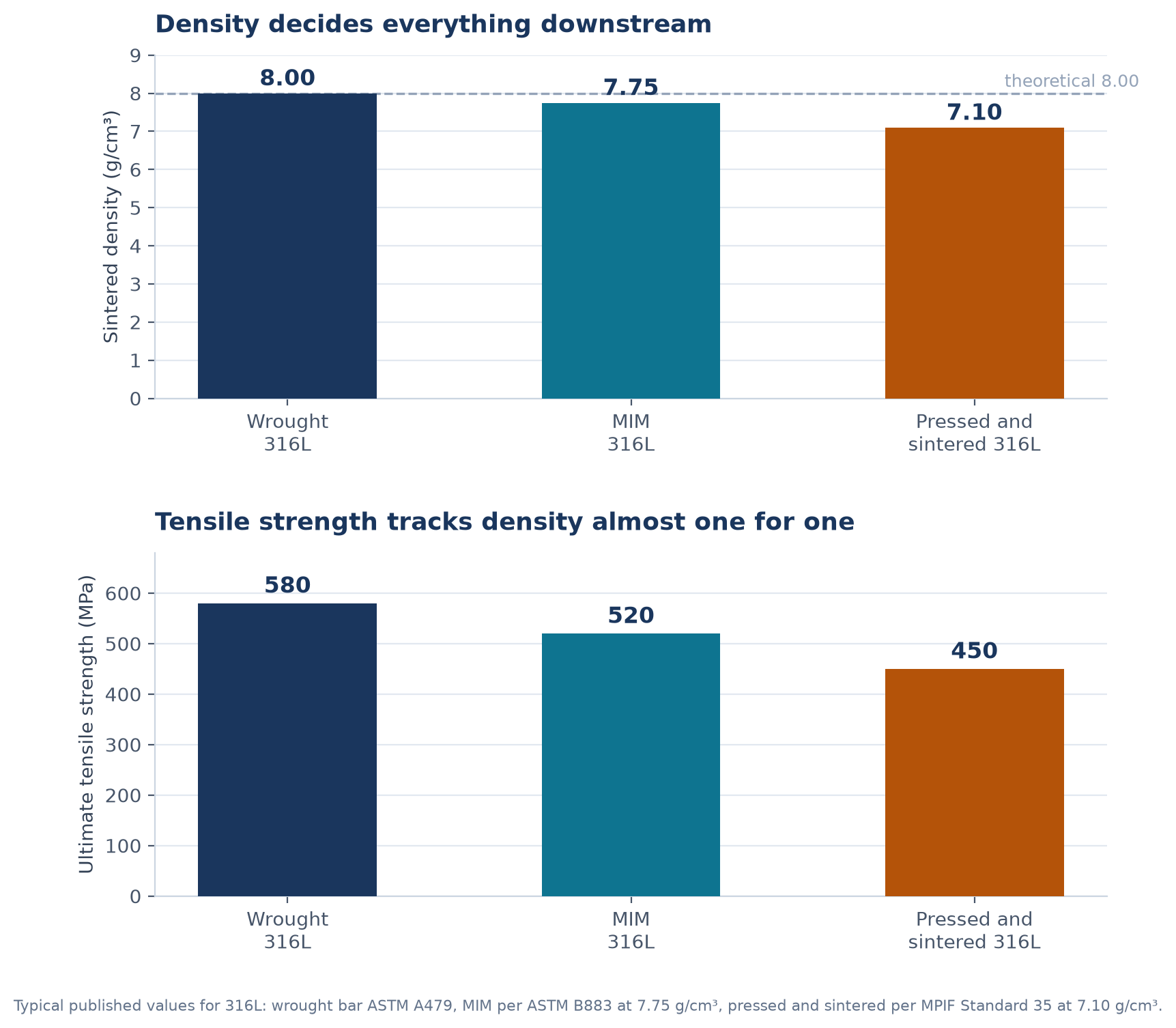
Read the elongation column twice before the tensile one. Losing half your ductility usually hurts more than losing 20 percent of your strength, because ductility absorbs the dropped carton and the overtightened fastener. The same pattern holds for precipitation hardening grades. Wrought 17-4PH in H900 gives 1,310 MPa and 10 percent elongation. MIM 17-4PH in H900 gives about 1,200 MPa and 7 percent. Both are strong. Only one forgives a rough thread.
Fatigue is the property nobody asks about until a bracket cracks. Wrought 316L holds roughly 240 MPa at 10 million cycles in rotating bending. Sintered 316L at 7.1 g/cm³ holds 100 to 130 MPa, and MIM at 7.75 g/cm³ holds 150 to 180 MPa. Pores act like notches cut into the surface. If the part sees vibration, double the section, add a HIP step, or machine the load path.
Tolerances and surface finish
As-sintered pressed parts hold about ±0.10 mm on dimensions under 25 mm, and ±0.05 mm where the tool adds a sizing pass. MIM holds ±0.3 percent of the dimension with a floor of ±0.05 mm, which works out to ±0.036 mm on a 12 mm feature. CNC turning and milling hold ±0.025 mm without drama and ±0.005 mm with a good fixture and a CMM to prove it.
Surface finish follows the same order. Pressed parts come out of the die at Ra 1.5 to 3.2 µm. MIM lands at Ra 0.8 to 2.0 µm because the cavity is polished and the part copies it. Machined 316L reaches Ra 0.8 to 1.6 µm off the tool and Ra 0.2 µm polished. You can tumble or brush a sintered part, but you cannot polish porosity out of the skin. Open pores show up as dull patches after electropolishing, and I have rejected sample lots for exactly that.
Corrosion behaviour of sintered parts
316L resists chloride attack by keeping a passive chromium oxide film intact, and pores interrupt that film. A pressed part at 7.0 g/cm³ has connected porosity, which means a chloride solution can travel into the body instead of sitting on the surface. Pitting starts inside a pore where nobody can see it until it breaks through the wall.
The figures I quote from ASTM B117 neutral salt spray, to the first rust stain: wrought 316L holds 300 to 500 hours, MIM 316L at 7.8 g/cm³ holds 150 to 300 hours, and pressed 316L at 7.0 g/cm³ holds 72 to 150 hours. Test setup moves those numbers by a factor of two, so treat them as a ranking, not a guarantee. Follow sintering with passivation per ASTM A967, and add resin impregnation when the part must hold pressure or fluid. Both steps cost cents per part. For what leaks through those pores and how to screen for it before shipment, see how to catch porosity issues before parts ship.
Cost per part and break-even volume
Here is the arithmetic I actually run, for a 40 mm 316L bracket at 10,000 pieces a year. CNC machining needs 400 dollars of programming and fixturing, then 9.50 dollars a part. Pressing and sintering needs a 15,000 dollar die, then 2.20 a part. MIM needs a 32,000 dollar mold, then 1.40 a part. Figure 2 shows what that does to unit cost as volume moves.
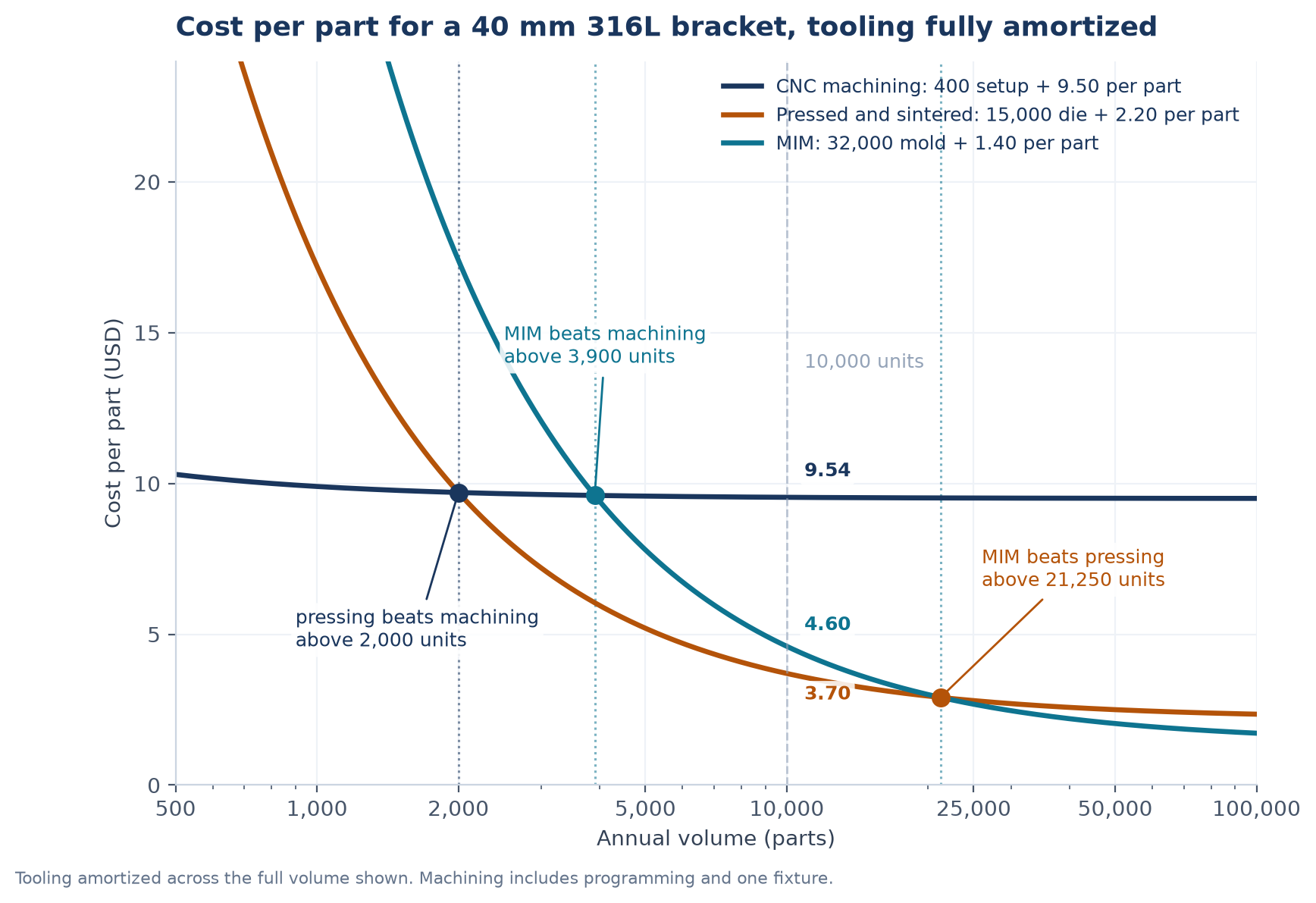
Pressing beats machining above 2,000 units. MIM beats machining above 3,900. MIM beats pressing above 21,250, which tells you the two sintering routes rarely compete; MIM exists for shapes a die cannot eject. At 10,000 pieces the bracket costs 9.54 dollars machined, 3.70 pressed, and 4.60 molded.
The number I care about more than the crossover is mold life expectancy. A 316L MIM mold with a P20 or H13 cavity runs 200,000 to 500,000 shots before the cavity needs rework. A pressing die runs 300,000 to 1,000,000 parts, and wear shows up first as a slow diameter drift, not as a broken tool. Ask for the expected shot count in writing before you amortize anything, and read what design changes reduce cost in powder metallurgy before you lock the drawing.
When machining still wins
Below roughly 2,000 pieces a year, machining wins on total cost and on schedule. I quote five working days for a machined bracket and 8 to 12 weeks for a new MIM mold. If the program is still iterating, that gap is the answer on its own. That decision is covered further in MIM versus CNC machining.
Machining also wins on the list that follows. A bore held to ±0.02 mm with a true position callout. Cross holes meeting at an angle. Threads below M2. A part heavier than 200 g in MIM or longer than 150 mm in pressed PM. Any part that needs wrought mill certification to ASTM A479. A medical implant housing needs most of that list, which is why those programs still start on a mill, and why both routes sit under one roof at our CNC machining and metal injection molding services.
The middle path is underused. Sinter the body and machine the two features that carry the tolerance. A MIM body at 1.40 dollars plus 0.90 dollars of secondary turning beats 9.50 dollars all-machined anywhere above 4,000 pieces. I have moved three programs to that model and none went back.
How I write the specification
Write the density, not the alloy name. "316L, 7.6 g/cm³ minimum, sintered" is a specification. "Stainless steel" is a wish.
Ask for tensile, yield, elongation and hardness from the same sintered coupon, on the same report as the chemistry. A certificate with chemistry only tells you what went into the furnace, not what came out. I walk buyers through the whole document in how to read a material certificate for 316L.
Put Cpk 1.33 on the one dimension that matters and let the rest run to the drawing's general tolerance. Sintered dimensions drift with die wear, and a supplier who tracks capability will tell you when a die touch-up is due rather than after the parts arrive.
For automotive programs, ask for PPAP Level 3 on the sintered part, same as you would on a machined one, and check the automotive requirements against your APQP schedule. For aerospace, AS9102 first article. A supplier who hesitates at either request is telling you something useful.
None of this is exotic. Sintered stainless is a mature process with published property data, and the figures above are the ones I check on every RFQ. Get the density written down, read the elongation column, and put the crossover volume in the quote comparison instead of in a slide. The how we work page and the FAQ answer the questions buyers send me most often.
FAQ
Is sintered stainless steel as strong as machined stainless steel?
No. Pressed and sintered 316L gives roughly 450 MPa ultimate tensile against 580 MPa for wrought bar, about 20 to 25 percent lower, and elongation drops from about 45 percent to under 20 percent. MIM 316L at 96 to 99 percent density closes most of that gap. Check the elongation column as well as the strength one.
What density should I specify for a sintered 316L part?
Write the number you need rather than the alloy alone. For a general part, 7.4 g/cm³ minimum is a sensible target. For a pressure-tight or fatigue-loaded part I write 7.6 g/cm³ minimum and ask for the measured value on the inspection report.
What is the cost per part difference between sintered and machined stainless steel?
At low volume machining wins because there is no tool. On a typical 40 mm bracket, pressing beats machining above about 2,000 units a year and MIM above about 3,900. At 10,000 units the bracket runs about 9.54 dollars machined, 3.70 pressed and 4.60 molded.
Can sintered stainless steel parts be machined after sintering?
Yes, and the hybrid route is common. Fully sintered 316L machines at speeds close to wrought material, with a small allowance for abrasive powder inclusions. I use it for bores, threads and faces that need better than the sintered tolerance, and the secondary operation usually adds 0.50 to 1.50 dollars a part.
Does sintering reduce the corrosion resistance of 316L?
It can. Porosity interrupts the passive film and gives chlorides a path into the body, so salt spray life drops from 300 to 500 hours on wrought material to 150 to 300 hours for MIM and 72 to 150 hours for pressed parts at 7.0 g/cm³. Passivation per ASTM A967 and, where sealing matters, resin impregnation bring most of it back.
Need Precision Metal Parts for Your Project?
Yujiaxin Tech specializes in MIM, CNC Machining, Powder Metallurgy, Investment Casting, and Gear Hobbing. Get a free quote within 24 hours.